In the 1998 thriller Ronin, Robert De Niro plays Sam, a wary ex-operative who refuses to walk into a meeting that doesn’t smell right. Pressed on it, he offers the rule he lives by: “Whenever there is any doubt, there is no doubt.” Asked who taught him that, he says he can’t remember — which, he deadpans, is the second thing they teach you.
The line long ago escaped the movie. You’ll hear versions of it from pilots, security professionals, and seasoned executives, usually delivered as settled wisdom. And it is wisdom — one of the most useful decision rules a project leader can carry. It is also, applied to the wrong kind of doubt, a reliable way to stall a career, starve a portfolio of good bets, and dress ordinary bias up as judgment.
So this post does two jobs. It shows you exactly when the maxim applies — and it gives you a two-question test for everything else. It’s the first in a five-part series on judgment under uncertainty for project leaders; links to the rest will be added below as they publish.
Why the rule works: asymmetric stakes
Doubt is information — probabilistic, fuzzy, incomplete. The maxim does something aggressive with that information: it converts a maybe into a hard no. When is that rational?
When the stakes are asymmetric. In Sam’s world, trusting the wrong person means dying; declining a meeting means inconvenience. Aviation runs on the same arithmetic. Pilots scrub takeoffs over an unexplained gauge reading, because a scrubbed flight costs an hour and some paperwork while an ignored warning can cost everything. The rule doesn’t ask whether the doubt is probably unfounded. It asks what each kind of mistake costs — and when the downside of misplaced trust dwarfs the downside of walking away, treating lingering doubt as a verdict isn’t paranoia. It’s math.
Project work serves up plenty of decisions with exactly that shape. A go-live with no rollback path. A vendor who will hold your customer data. A hire into the one role where a quiet breach of trust could sink the program. In those rooms, Sam’s rule belongs on the wall.
But notice what the rule quietly requires: the asymmetry. Plenty of project decisions don’t have that shape. Hiring a junior analyst on a 90-day trial is not a Paris ambush. Piloting a new tool in one workstream is not a go-live with safety implications. Which is why the sorting below matters more than the maxim itself.
Do you OODA??? Master Decision-Making using the OODA Loop
Three species of doubt — and only one is a verdict
When doubt shows up, first identify which kind you’re holding.
Evidence-doubt. You did the diligence — called the references, asked the direct question, re-ran the numbers — and the unease is still there. Doubt that survives honest inquiry is a finding. This is the maxim’s home turf.
Ignorance-doubt. You’re unsure because you don’t yet know enough. That’s not a verdict; it’s an errand. If one phone call, one document, or one site visit could dissolve the doubt, the maxim doesn’t apply — the phone call does.
Anxiety-doubt. The queasy feeling before a stretch assignment, a certification exam, a first presentation to the steering committee. This is usually information about preparation, not about the path. Growth has a nervous edge; that’s the price of admission, not a red flag.
One caution before you trust any of them: a “gut feeling” that can’t point to a single observable behavior deserves interrogation itself, because bias is fluent in the language of doubt. (Post 2 gives that safeguard a full treatment.)
The most expensive judgment errors are filing errors. Treat anxiety as evidence and you’ll shrink from every stretch role you were ready for. Treat evidence as anxiety and you’ll talk yourself into the hire you already know is wrong.
From Data Hoarders to Decision Machines: How Elite Project Leaders Extract Gold from Information
The two-question doubt test
Once you know the species, run two questions.
- Is this about integrity or capability? Doubt about whether someone is telling you the truth — a candidate, a vendor, a status report — carries categorically more weight than doubt about whether they can do the job. Capability is coachable, testable, and improvable on your timeline. Character isn’t. A person who shades the truth on small, verifiable things has told you something that tenure will not fix.
- Is the door one-way or reversible? A multi-year contract, a key hire into a trust-critical role, a launch with safety or reputational stakes — one-way doors. A pilot program, a trial period, a staged investment — reversible ones. The maxim’s full force is reserved for one-way doors. Reversible doors are where you test doubt cheaply instead of obeying it.
Cross the answers and your posture falls out. Integrity doubt at a one-way door: any doubt, no doubt — stop. Capability doubt at a reversible door: give room, run the test, coach the gap.
The mixed cases reward one more beat of thought. Capability doubt at a one-way door doesn’t have to end in a veto — often you can change the door: stage the rollout, add a checkpoint, make the irreversible thing reversible, and then test. Integrity doubt at a reversible door tempts you to shrug — “we can always exit” — but exit options are for capability experiments, not for tolerating dishonesty. Small breaches predict large ones, and the cheap exit has a way of never being exercised. When truth is the question, act early.
Never Let a Good Crisis Go to Waste: Turning Setbacks into Opportunities for Growth
The rationalization tell
Here is the most practical signal in this whole post: notice the moment you start building a case against your own doubt.
A fourth interview scheduled in the hope of feeling differently. A business case re-run with friendlier assumptions. One more “alignment call” with a vendor whose last three answers didn’t add up. That effort is itself the data. If the facts had resolved your doubt, you wouldn’t be assembling arguments against it.
There’s an honest version of this activity, and the difference is direction. Gathering information to answer a question is diligence. Gathering support to silence a feeling is the tell. The clean formulation: initial uncertainty is a to-do list; residual doubt — the kind still standing after honest inquiry — is a verdict. You’ve crossed from one to the other at the moment you catch yourself lawyering against your own judgment.
Good vs. Wise Decisions in Project Management: The Subtle Difference That Shapes Outcomes
Where the test earns its keep
Project leadership is a parade of exactly these calls, and the rest of this series walks the maxim through each arena: the people you hire and trust (Post 2); the green status report you’re not sure you believe (Post 3 — link coming); the career move where you can’t tell red flags from nerves (Post 4 — link coming); and, in the finale, the counterweight — the situations where real doubt is present and the right move is still to bet, carefully (Post 5 — link coming).
Removing doubt by design: how professionals commit
One more thing the pilots can teach us. Seasoned operators don’t summon confidence at the moment of a high-stakes commitment — they engineer the doubt out beforehand. Nobody feels brave about a takeoff; they trust the checklist that preceded it.
For many professionals, the PMP® certification decision has that high-stakes shape: a real exam fee, months of preparation, one exam day — and, since July 2026, an updated exam format to prepare against. You can meet that with willpower. Or you can meet it with structure.
The PMP® Exam Is Changing on July 9, 2026 — What’s Different and How to Prepare
Structure looks like the PMP Live Class from Master of Project Academy: four days and 35 contact hours with a live instructor you can interrogate in real time, in sessions capped between 3 and 25 participants so your questions actually get answered. The schedule publishes which sessions are Guaranteed to Run, so calendar risk is visible instead of hidden. And the track record answers the biggest doubt head-on: a 99.6% first-time pass rate, audited through the company’s Better Business Bureau accreditation.
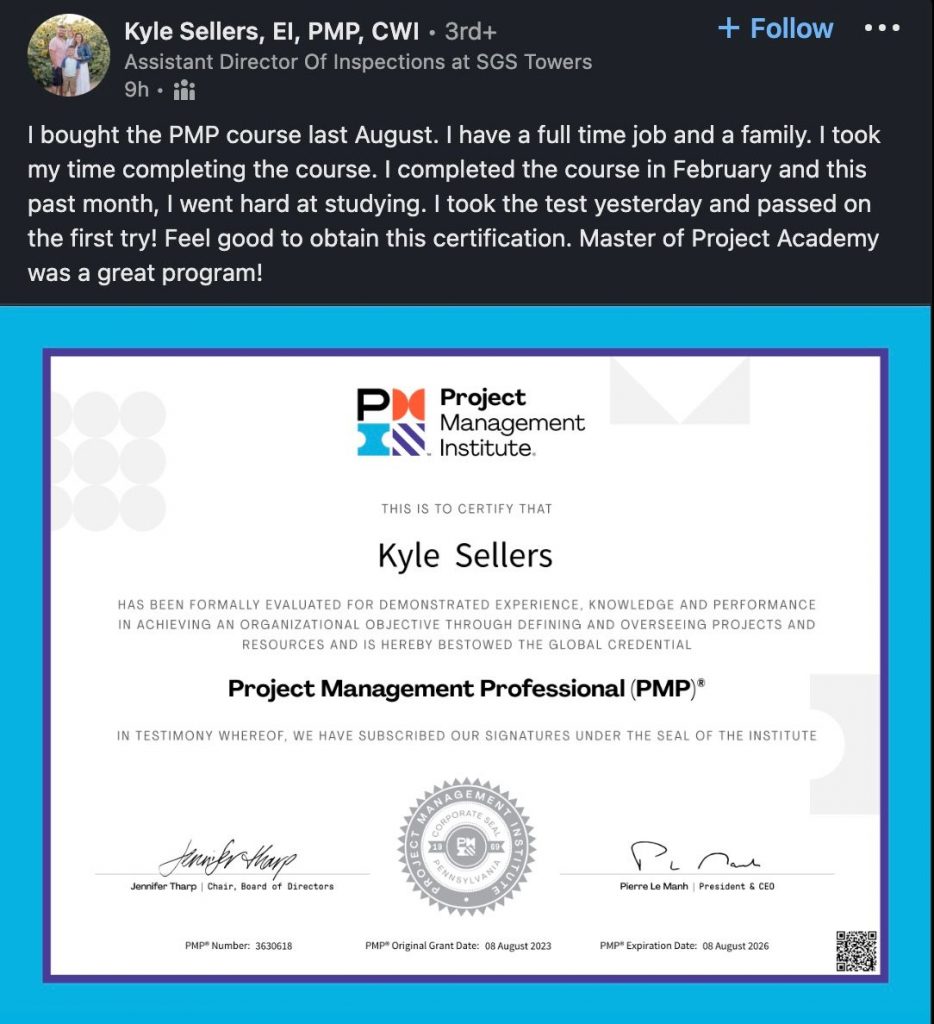
Both plans — Standard at $1,079 and Pro at $1,279 — include lifetime access to the full self-paced PMP course, so nothing you learn expires when the class ends. Pro adds a one-hour, one-on-one PMP coaching session: a private forum for whatever doubt survives four days of live instruction.
Check current dates and reserve a seat here.
The rule — and the exception
Carry the maxim; it earns its keep. Reserve its full force for integrity doubts at one-way doors. Run the two-question test everywhere else. And watch for the moment you start arguing with your own judgment — that’s usually the verdict, announcing itself.
Then come back for the finale, where we make the opposite case: when there is doubt — and you should go anyway.