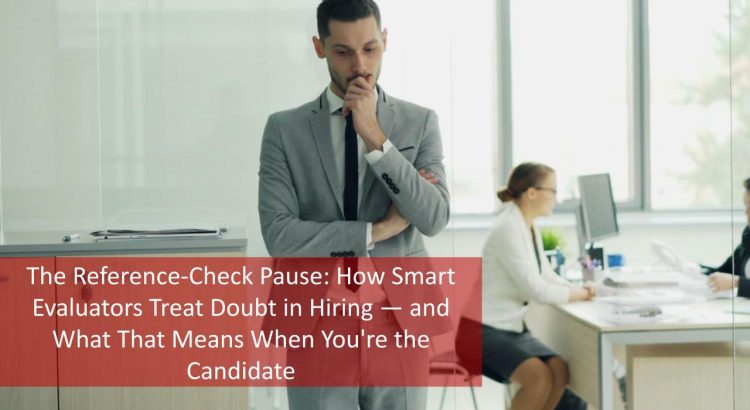
You’re on the phone with a candidate’s former manager. You ask the only reference question that matters: “Would you hire them again?” And there it is — a beat of silence, then careful words. “In the right environment… I think they could do well.”
Nothing negative was said. Everything was said.
In the first post of this series, we borrowed an operative’s maxim — whenever there is any doubt, there is no doubt — and built a two-question test around it: Is the doubt about integrity or capability? Is the door one-way or reversible? Nowhere does that test earn its keep faster than in decisions about people: who to hire, who to promote, which vendor to trust. And nowhere is it easier to misuse. This post covers both.
The pause is data
Reference culture is polite by design. References are hand-picked by the candidate; the base rate is warmth. Which is exactly why deviations from warmth carry so much information: the hesitation, the qualified praise, the compliment aimed carefully at something small (“always very punctual”), the lawyerly retreat to “I can confirm the dates of employment.”
You’re not listening to the words. You’re listening to the effort behind them.
A pause is not a verdict on its own — it’s a doubt that now exists and must be resolved, not overridden. Resolve it with behavior-specific follow-ups: “Tell me about a time they had to deliver bad news to leadership.” “What would their team say it was like to work for them?” What you cannot do is hang up and pretend you didn’t hear it.
Do You Have Wise Team Members? 5 Traits That Turn Project Chaos Into Calm (and How to Develop Them)
Integrity or capability: the only sorting that matters
The cornerstone rule applies with full force here: capability is coachable, testable, and improvable on your timeline. Character isn’t.
In people decisions, that cashes out cleanly. A candidate missing a skill is a training plan. A candidate who inflated a title is a forecast. Performance plans fix skills; they do not fix honesty. So sort every doubt you’re carrying about a person into one of two bins. Can they do it? — give room. Probation periods, paired work, and staged responsibility are cheap, fair tests, and plenty of great careers began with someone extending exactly that room. Can I trust what they tell me? — that bin gets the maxim.
Exceptional Companies Hire for Values First, Aptitude Second, and Skills Third: Here’s Why
Small lies about verifiable facts
Why obsess over trivial fibs — dates nudged to close an employment gap, “led” where “participated” was the truth, a certification listed as earned that’s actually “in progress”?
Because of what they predict. Someone willing to shade the truth when the stakes are low and verification is one phone call away has shown you their settings. High-stakes moments raise the temptation, not the honesty. This is the asymmetry from Post 1 in miniature: hiring the truthful-but-greener candidate costs you some ramp time; hiring the polished fabricator costs you the one thing a project actually runs on — the reliability of what you’re told.
The brilliant jerk
Sooner or later every leader faces the highest performer whose behavior generates doubt across a whole team: credit taken, information hoarded, contempt flashed at juniors. And every leader hears the same internal counsel: the output is worth it.
Notice what that voice is doing — it’s the rationalization tell from the cornerstone, a case being built against your own doubt. The brilliant jerk’s costs are real but distributed and delayed, which is precisely why the doubt gets overridden: colleagues start routing around them, juniors stop asking questions, problems stop traveling upward. One day your status reports read green while the project quietly reddens underneath. The output was visible on every dashboard; the trust damage compounded off the books.
Boosting Project Team Morale and Motivation: Proven Techniques for Keeping Your Team Engaged
Vendors and partners: doubt gets a multiplier
People decisions don’t stop at employees. A vendor is a hire you can’t manage day-to-day, wrapped in incentives that aren’t yours. That’s why courtship-phase doubt deserves extra weight, not less: the demo, the proposal, the pilot — this is the counterparty on its best behavior. Evasive now means evasive during the escalation, when it costs you.
The practical moves: call their former clients, not just the current ones they offer; verify claims independently instead of accepting the deck; stage the contract so early exits are real rather than theoretical. And if the doubt is about whether they’re being straight with you — a number that shifted between meetings, a promised reference that never materializes — remember which bin that goes in.
The safeguard: name the behavior
Now the warning label, because in people decisions the maxim has a failure mode: bias is fluent in the language of doubt. “Something’s off.” “Not a culture fit.” “I just can’t picture them in front of the client.” Sometimes those sentences are judgment. Sometimes they’re pattern-matched familiarity — schools, accents, hobbies, demographics — wearing judgment’s clothes.
The safeguard is one sentence: “I doubt this person because I observed ______.” If the blank holds a behavior — a shaded fact, a reference’s pause, a flash of contempt in the interview — the doubt is admissible. If the blank holds a vibe, the thing that needs interrogating is the doubt, not the person. Fair process isn’t the enemy of the maxim; it’s what keeps the maxim honest.
What “Sound Judgment” Means at Work in 2026 (And How to Prove You Have It)
Flip the lens: you’re the one being doubted
Here’s the part evaluators know and candidates forget: every résumé screen, every panel interview, every promotion case is someone running this exact test on you.
And most of what a résumé asserts is unverifiable on its face. “Strong leadership skills.” “Results-driven.” “Excellent communicator.” An evaluator can’t test any of that, so they hunt for the signals they don’t have to take on faith: third-party, audited, verifiable. That is the actual function of a certification. The PMP® isn’t a magic word — it’s a doubt-delete. PMI-verified experience hours, a proctored exam, a public credential registry: it converts “trust me, I can run projects” into a claim the evaluator doesn’t have to doubt. The market prices that reduction — PMI’s Earning Power salary survey found PMP holders reporting around 20% higher average salaries than their uncertified peers. And there’s a newer doubt sitting on evaluators’ minds — can this PM actually work with data and AI tools, or just talk about them? — which is answerable the same way: with something verifiable.
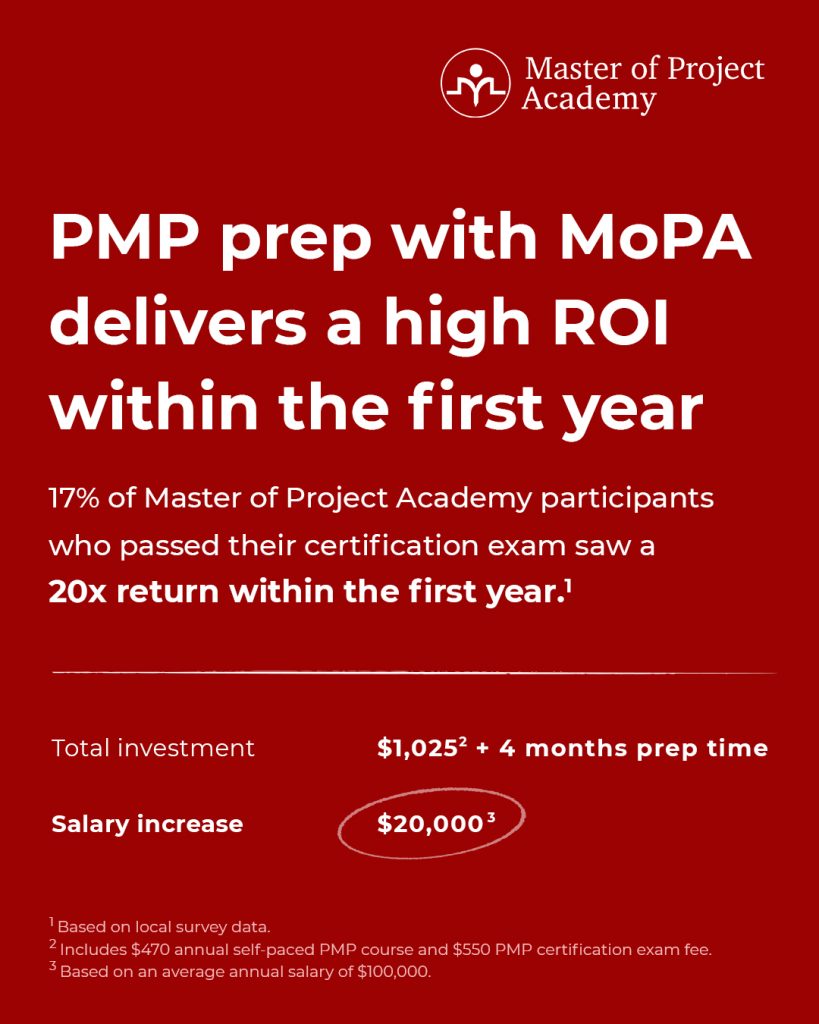
If you’re preparing to pass that test, the PMP® Certification Online Training Bundle from Master of Project Academy is built as a doubt-removal kit — for the evaluator’s doubt and for yours. Six courses: the 35-contact-hour self-paced PMP training that satisfies PMI’s education requirement, plus 9 realistic sample exams with 2,400+ practice questions — so exam day is your tenth attempt, not your first. That’s the private version of doubt-removal: walking in with evidence you can pass, because you already have, nine times. The bundle rounds out with Microsoft Project for the Web, Agile Scrum, and the two courses that answer the modern-PM question before it’s asked — Introduction to Analytics & AI and Power BI, the start of the AI-First Project Manager path. It’s fully self-paced around a full-time job, with plans from $117/month plus annual and lifetime options. And if your doubt is about the application itself or your study plan, a one-hour, one-on-one PMP coaching session resolves in sixty minutes what forums debate for weeks.
Be the candidate with no pause
The next time you’re the one holding the phone, listening for the pause: sort the doubt, name the behavior, and let the maxim do only its rightful work. And when you’re the one being evaluated, remember the flip side. The strongest position in any hiring process is being the candidate about whom there is no pause.
Next in the series: what to do when the project might be lying to you — the status report that’s green on the outside and red underneath.