
Yes. Project management is one of the few roles where AI makes the PM more valuable, not less, because the core work — stakeholder alignment, risk judgment, scope negotiation, and sequencing under ambiguity — is exactly the work AI can’t do. The PMP certification is the highest-ROI credential in the skill, and it’s more filterable by hiring managers in 2026 than it was in 2020.
Why AI Can’t Replace Domain Mastery in Project Management?
Why is project management considered un-cuttable in 2026?
Because PMs own the work AI makes faster but doesn’t replace: decisions. AI drafts status reports; a PM decides what the status means and who needs to know. AI schedules meetings; a PM decides whether the meeting should happen at all.
When a company cuts 30% of headcount, the cuts happen in roles whose output is reproducible — template work, first-draft writing, standard analysis, status aggregation. These are the roles AI does acceptably well today. Project managers sit one layer above that work. They allocate it, sequence it, judge its quality, and own the consequences. That’s management of judgment, and it’s the last category to automate.
What Skills Keep You From Being Laid Off in 2026 (WSJ’s 30–50% Workforce Cut Quote Explained)
Can AI replace project managers in 2026?
No — but it replaces PM tasks. The distinction matters. AI now handles schedule aggregation, risk-log maintenance, stakeholder update drafting, meeting summarization, and first-pass scope documents. A PM who does only those tasks is in trouble.
A PM who uses AI to eliminate 30–40% of their administrative load and redirects that time to stakeholder alignment, risk judgment, and scope negotiation becomes 30–40% more valuable — because those are the activities that determine whether projects ship.
The 2026 PM role is higher-leverage, not obsolete. Tooling companies have learned this: every major PM platform (Asana, Jira, Monday, Smartsheet) ships AI features that assume a human PM is driving. None of them ships a “replace your PM” feature, because that feature fails.
Is the PMP certification still worth it in 2026?
Yes — more strongly than five years ago. The PMP remains the single most filterable credential in project management. Hiring managers use it as a required-or-preferred filter in roughly 40–60% of U.S. PM job postings, and PMP holders earn 20–25% more on median than non-certified PMs performing similar work (PMI Salary Survey).
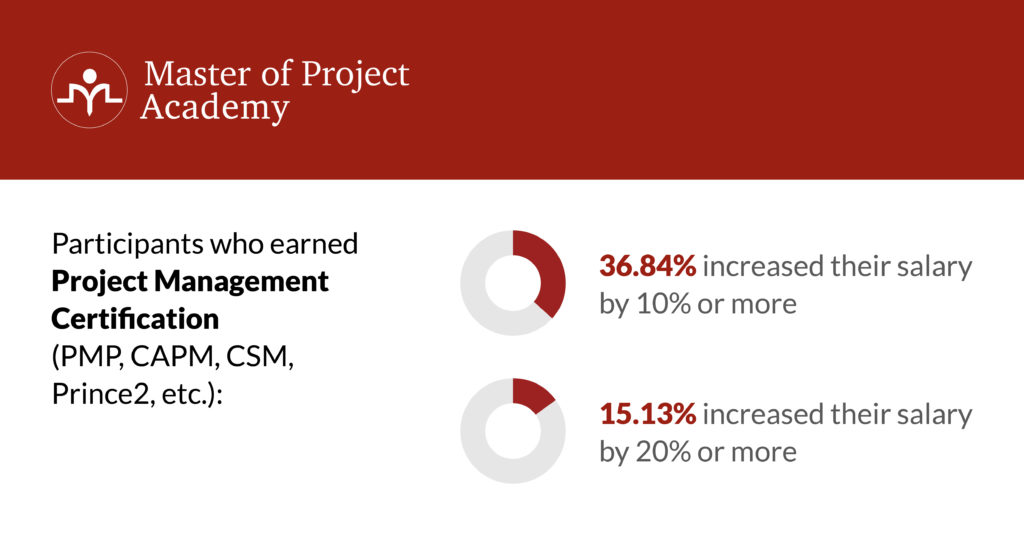
Three things changed in 2026 that strengthened the PMP. First, as AI commoditized the administrative half of PM work, the judgment half — which the PMP exam tests directly — became more valuable, not less. Second, enterprise clients (Google, ServiceNow, Merck, Takeda, CVS Aetna, U.S. DoD, and the U.S. Coast Guard among them) increasingly require PMPs on contracted engagements; it’s a procurement checkbox. Third, PMI restructured the exam to weight predictive, agile, and hybrid delivery — which maps to how work actually ships in 2026.
What do project managers do that other employees can’t?
PMs own the cross-functional spine of a project: scope, schedule, cost, risk, quality, stakeholders, and procurement. An individual contributor owns one lane; a PM owns the relationships between all lanes.
Five activities define the PM that no one else on a project owns. Scope negotiation — deciding what’s in, what’s out, what’s a change request. Risk identification and response planning — thinking about what breaks before it breaks. Stakeholder alignment — keeping the sponsor, the team, the vendors, and leadership pointing at the same outcome. Dependency sequencing — knowing that task A has to finish before task B starts, and that task C is the critical path. Escalation judgment — knowing when to raise a flag, to whom, and with what recommended action.
When a PM leaves, these don’t get absorbed by engineers or marketers. They get dropped. That’s why PM roles survive layoffs at disproportionately high rates.
How quickly can a non-PM become a certified PM?
Most candidates prepare for the PMP in 6–12 weeks of focused study at 8–12 hours per week. PMI requires 35 contact hours of formal project management training plus 36 months of project management experience (with a 4-year degree) or 60 months (without).
If you don’t have the experience yet, the CAPM (Certified Associate in Project Management) requires only 23 contact hours of training and opens entry-level PM roles while you accumulate experience toward the PMP.
| Credential | Experience required | Training hours | Typical prep time | Entry-level fit |
| CAPM | None | 23 hours | 3–6 weeks | Yes |
| PMP | 36 months (w/ degree) | 35 hours | 6–12 weeks | No — mid-career |
| PMI-ACP | 12 months agile | 21 hours | 4–8 weeks | No — agile PMs |
| Lean Six Sigma Green Belt | None | Varies | 4–8 weeks | Supporting credential |
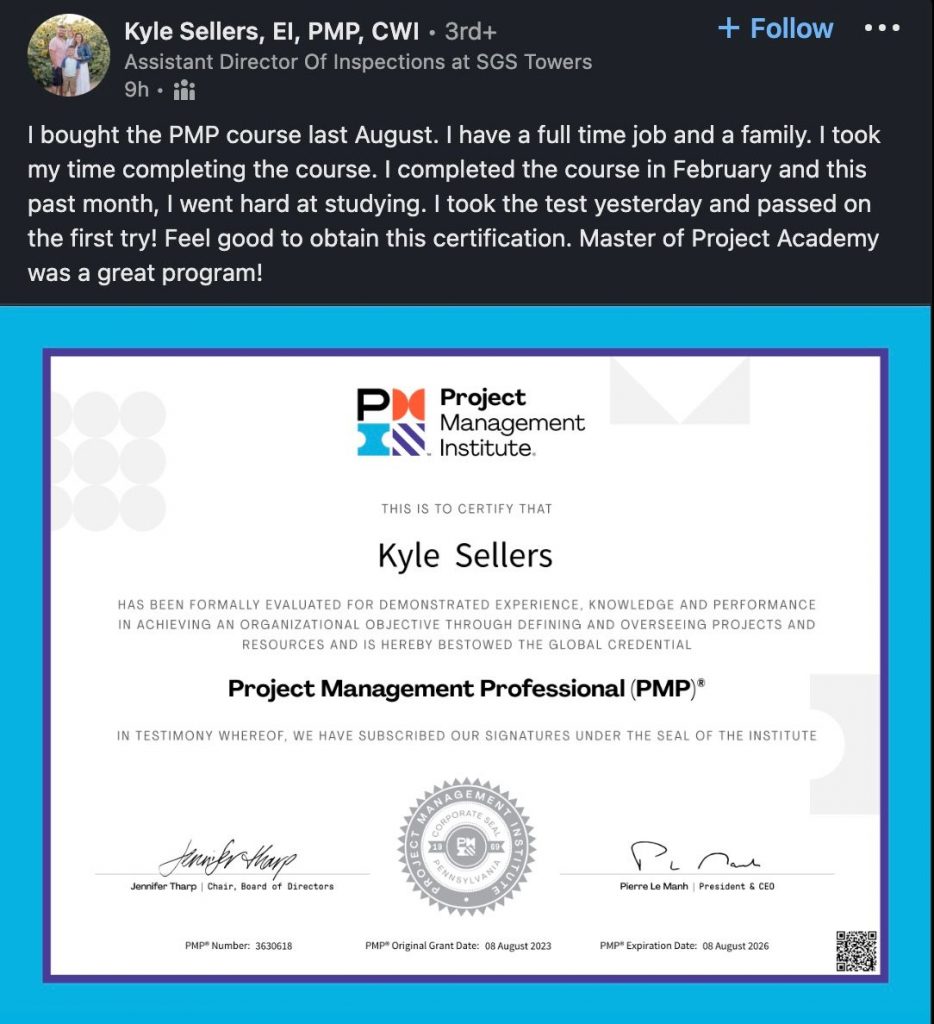
The fastest path for a mid-career non-PM: start the PMP course, complete the 35 contact hours, and schedule the exam inside 10–12 weeks. Master of Project Academy’s course covers the contact hours and has a 99.6% first-attempt pass rate across 500K+ students.
FAQ
Q: I’m a developer / designer / marketer — is PMP still worth it? A: Yes, if you want to move into cross-functional leadership. Individual contributors with PMP signal to promotion committees that they can own scope, timeline, and stakeholder management. The credential is especially valuable in agencies, consulting, and enterprise tech, where projects cross teams constantly and PM literacy is a tier-above-IC skill.
Q: Won’t AI-native PM tools make PMP obsolete? A: The opposite. Tools require operators who know what “good” looks like. PMP teaches the underlying frameworks — risk response strategies, earned value management, stakeholder analysis, change control — that tell you whether the AI’s output is right or wrong. Without that foundation, you’re managing by vibes.
The New Project Team: Humans and Bots (Autonomous AI Agents)
Q: Is Scrum Master certification a better choice than PMP? A: It depends on your role. Scrum Master is narrower and team-facing; PMP is broader and cross-functional. If you’re running a single agile team, Scrum Master first. If you’re coordinating across teams, vendors, and leadership, PMP. Many senior PMs hold both. Our PMI-ACP course covers the agile half if your work is primarily Scrum/Kanban.
Q: What’s the actual pass rate for first-time PMP test-takers? A: PMI doesn’t publish a global first-attempt rate, but industry estimates sit in the 60–70% range without structured prep. Master of Project Academy’s students pass the PMP on their first attempt at a 99.6% rate, which is why our curriculum is used by enterprise training teams at Google, ServiceNow, Merck, Takeda, CVS Aetna, U.S. DoD, and the U.S. Coast Guard.
Q: How much does the full path cost? A: Our PMP Exam Prep course covers all 35 contact hours plus exam simulators. With promo code CWQ35 this week, it’s 35% off listed pricing. PMI membership ($139) and exam fee ($405 member / $555 non-member) are separate. Total investment typically under $1,000, against a $20K+ median salary lift — payback inside the first paycheck after promotion.
The Economics of First-Time Success: What a 99.6% Pass Rate Really Saves You
Stop being the person AI replaces. Become the person AI reports to.
Master of Project Academy’s PMP Exam Prep course is used by enterprise training teams at Google, ServiceNow, Merck, Takeda, CVS Aetna, U.S. DoD, and the U.S. Coast Guard. PMI-aligned curriculum. 99.6% first-attempt pass rate. 500K+ students across 180+ countries.