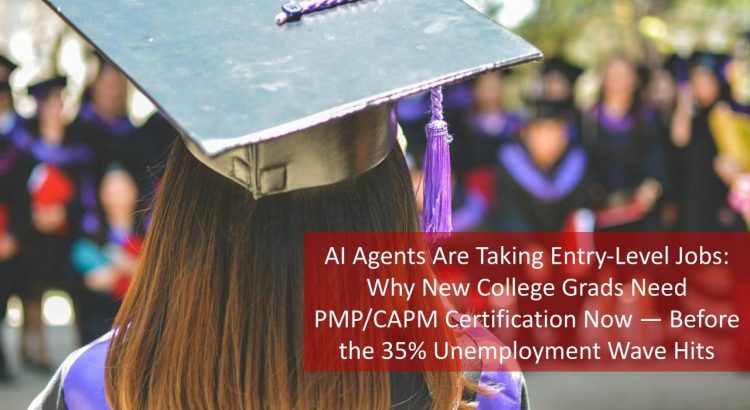
ServiceNow CEO Bill McDermott warns that college grad unemployment could surge from 9% to the mid-30s within two years as AI agents absorb undifferentiated work. Here is exactly what that means — and how project management certification gives new graduates the one thing AI cannot replicate: the ability to manage outcomes.
The Warning Every New Graduate Needs to Read
In March 2026, Bill McDermott, CEO of ServiceNow — the $130-billion enterprise software company — appeared on CNBC’s Squawk on the Street and made a statement that should be required reading for every university career center, every graduating senior, and every parent writing tuition checks.
“I think young people coming out of university today is like 9% unemployment,” McDermott said. “I think it could easily go into the mid-30s in the next couple of years.” The reason, he explained, is unambiguous: AI agents are now performing the non-differentiating tasks that entry-level roles were historically built around.
For context, a jump from 9% to 35% graduate unemployment would be the most severe structural disruption to the entry-level job market in living memory. This is not a distant projection. Companies like Block, Atlassian, and ServiceNow itself have already started demonstrating it.
ServiceNow reported that its AI platform has eliminated 90% of the customer service use cases that previously required human employees — while simultaneously growing revenue. That is the template being copied across every major industry.
This article breaks down exactly what is happening, why it is accelerating faster than most people expect, and how Master of Project Academy’s PMP and CAPM certification programs position new graduates on the right side of this historic divide.
What Is Happening to Entry-Level Jobs — and Why Now?
What work are AI agents actually replacing?
AI agents are software systems capable of completing end-to-end tasks autonomously — not just generating text, but taking action, making decisions within defined parameters, and routing outcomes. In enterprise environments, they are being deployed across:
- Customer service triage and resolution
- Data entry, processing, and reporting
- First-pass document review and summarization
- Quality assurance and testing workflows
- Research aggregation and briefing preparation
- HR onboarding coordination and scheduling
- Basic financial reconciliation and audit prep
These are precisely the categories of work that new college graduates have historically occupied for the first two to five years of their careers. This is not low-skill work being automated — these are knowledge-economy entry points that taught professionals how organizations function from the inside.
Project Management in the Age of AI: A Comparative Analysis of Jira, Asana, and Other Emerging Tools
Why is this disruption happening faster than previous automation waves?
Previous automation waves (manufacturing robotics, ATMs, early software) displaced physical or highly repetitive labor. The AI agent wave targets cognitive, coordinative, and communicative work — the exact profile of a white-collar entry-level employee.
The economics are also compelling for corporations in a way that is qualitatively different. McDermott described how ServiceNow can maintain the same headcount going into a year as it exits with, while expanding free cash flow margins and growing revenues. Translated: hiring freezes and reduced backfills are now productivity strategies, not emergency cost cuts.
The Federal Reserve Bank of New York put graduate underemployment at 42.5% by end of 2025 — the highest since 2020 — before the current wave of agent deployments had fully rolled out. The baseline was already deteriorating. The catalyst has now arrived.
| Is your career AI-proof? Start with CAPM — the entry-level PM certification built for this moment. |
Why a Degree Alone No Longer Differentiates New Graduates
What does ‘undifferentiated’ work actually mean in this context?
McDermott used the phrase ‘non-differentiating roles’ deliberately. Undifferentiated work is work that can be specified, replicated, and measured without requiring contextual judgment, stakeholder intuition, or organizational authority.
A degree certifies that a graduate completed a curriculum. It does not certify that they can manage a cross-functional team, negotiate scope with a difficult stakeholder, identify risk before it becomes a crisis, or own an outcome that depends on dozens of moving parts.
AI agents can do undifferentiated work. They cannot own outcomes. That distinction is now the most important line in any professional’s career profile.
What does the data show about the current graduate job market?
| Metric | Figure (2025) |
| Graduate unemployment rate | 5.7% (NY Fed, end of 2025) |
| Graduate underemployment rate | 42.5% — highest since 2020 |
| ServiceNow CS roles replaced by AI | 90% of prior human use cases |
| Block workforce reduction | ~50% headcount cut due to AI |
| McDermott’s 2-year forecast | Mid-30s graduate unemployment |
These are not speculative numbers. They are the current baseline before agent deployment reaches its next adoption curve.
You were not hired to be the agent. You were hired to manage the outcome. PMP and CAPM certification teaches you how.
What Skills Are Actually AI-Resistant — and How Do PMP and CAPM Teach Them?
Which professional capabilities cannot be automated?
The skills that remain definitively human in the AI-agent era share a common thread: they require contextual authority, relational trust, and dynamic judgment in environments that cannot be fully pre-specified. These include:
- Stakeholder alignment — negotiating competing priorities among people with organizational power
- Risk identification and escalation — judgment calls that require understanding of political and operational context
- Scope governance — protecting project boundaries against scope creep in environments with ambiguity
- Communication and expectation management — translating technical complexity for executive audiences
- Accountability and outcome ownership — standing behind a deliverable that crosses multiple teams and systems
- Adaptive planning — replanning in real time when conditions change faster than any model can predict
These are not soft skills. They are high-leverage, high-consequence capabilities that determine whether organizations succeed or fail at executing their most important work.
How does PMP certification develop these capabilities?
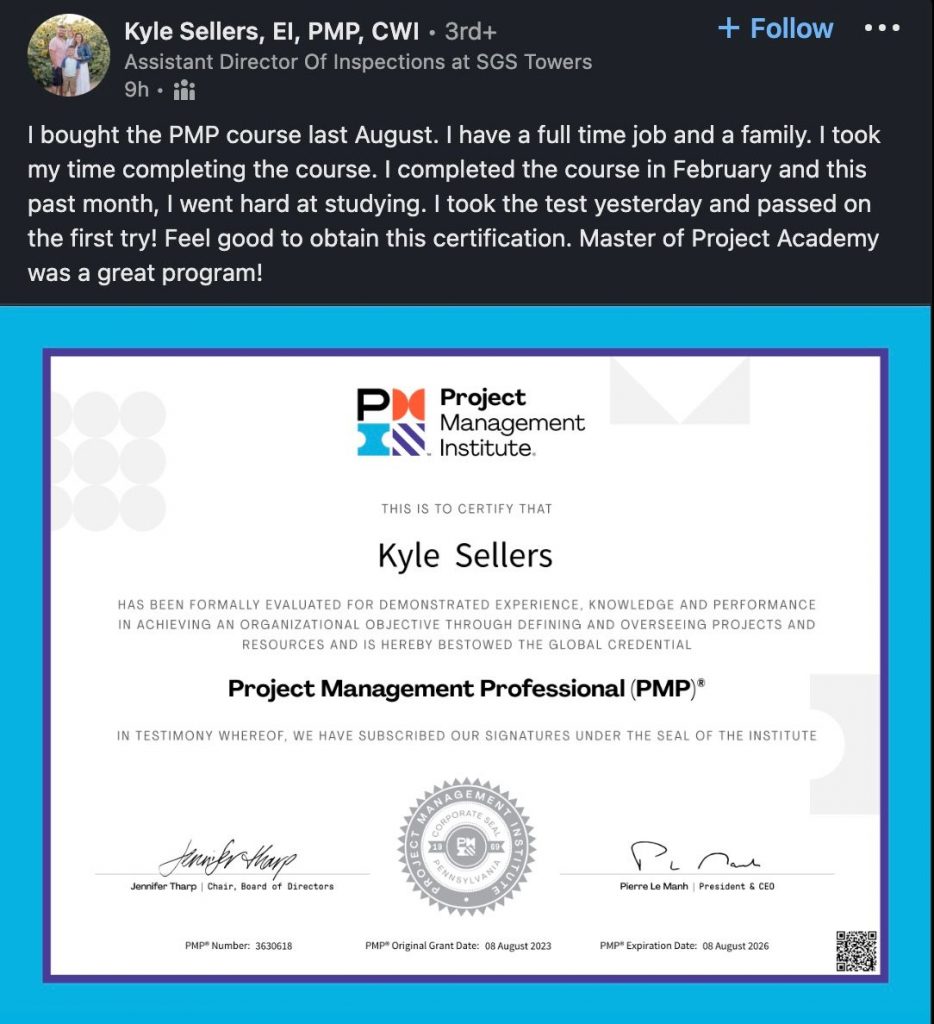
The Project Management Professional (PMP) certification, issued by the Project Management Institute (PMI) and recognized in over 180 countries, is the globally accepted standard for outcome-focused professional practice. It is built around three performance domains — People, Process, and Business Environment — that map precisely to the skills AI agents cannot replicate.
Master of Project Academy’s PMP preparation program has delivered a 99.6% first-attempt pass rate across more than 500,000 students. The curriculum teaches not just exam content, but how to think about projects the way senior executives think about them: in terms of risk, value, stakeholder impact, and strategic alignment.
Who is CAPM designed for, and why is it ideal for new graduates specifically?
The Certified Associate in Project Management (CAPM) is PMI’s entry-level certification. It requires no prior project management experience, making it the ideal credential for college graduates and early-career professionals who need to differentiate themselves before they have a long work history to point to.
CAPM demonstrates to hiring managers that a candidate understands the language, frameworks, and discipline of structured project execution. In a market where AI agents handle the task layer, CAPM signals that a candidate operates at the outcome layer — exactly where organizations need human judgment.
| CAPM is the entry-level PM credential that signals you manage outcomes, not just tasks. |
How Does Master of Project Academy Specifically Position New Graduates?
What makes Master of Project Academy different from other PMP and CAPM prep providers?
Master of Project Academy has trained over 500,000 professionals across 180+ countries with a 99.6% first-attempt PMP pass rate — the highest in the industry. Its corporate clients include Microsoft, IBM, Deloitte, and CVS Aetna, which means the credential and curriculum are validated at the enterprise level where hiring decisions are actually made.
The platform’s instruction is built on real practitioner experience, not theoretical frameworks alone. Courses are designed to translate directly into workplace performance — not just exam success.
What specific outcomes can a CAPM-certified graduate expect in the job market?
A CAPM-certified graduate enters job applications with a PMI-recognized, globally accepted credential that signals three things hiring managers are actively looking for in the AI era:
- Structured thinking — the ability to break ambiguous problems into manageable, trackable work
- Process discipline — familiarity with methodologies that prevent projects from drifting into chaos
- Professional seriousness — the initiative to pursue certification before being required to, which signals ownership mindset
Beyond the credential itself, CAPM serves as the foundation for PMP certification, which is widely recognized as the most valuable project management credential in the world. New graduates who earn CAPM now are positioning themselves for PMP eligibility within two to three years — creating a career differentiation runway that extends far beyond the current AI disruption moment.
When AI agents take the undifferentiated work, Master of Project Academy gives new grads the differentiated skills that cannot be automated — project leadership, process mastery, and professional certification.
The New Project Team: Humans and Bots (Autonomous AI Agents)
What Should New Graduates Do Right Now? A Practical Action Plan
Step 1: Understand the distinction between task work and outcome ownership
Before updating a resume or applying to any role, graduates need to internalize the core mental shift: AI agents are task executors. Employers are now hiring humans exclusively for capabilities that require judgment, accountability, and relational authority. Every career decision should flow from this understanding.
The uncomfortable question: If AI can plan, summarize, and automate… do we still need PMP holders?
Step 2: Get CAPM-certified before the next hiring cycle
The CAPM exam can be completed within weeks with the right preparation program. Master of Project Academy’s CAPM bundle provides structured, practitioner-led instruction with a proven track record. Earning CAPM before the next hiring wave means entering a compressed, competitive market with a credential that immediately differentiates a candidate from the majority of applicants.
Step 3: Frame every professional experience around outcomes, not activities
On resumes, in interviews, and in networking conversations, graduates should reframe their history from activity-based descriptions to outcome-based narratives. Not ‘I assisted with reporting’ — but ‘I identified a data discrepancy that prevented a $40,000 billing error.’ AI does activities. Humans own outcomes.
The Power of Authentic Curiosity: A Hidden Advantage in Learning, Leadership, and the AI-First World
Step 4: Build toward PMP within three years
CAPM is the entry point. PMP is the destination. Master of Project Academy’s curriculum is designed to move students along this path efficiently, with PMP preparation that builds directly on CAPM fundamentals. The PMP is the most recognized project management credential globally and commands a significant salary premium across every industry and geography.
From Contributor to Change Leader: A Self‑Assessment Framework for Project Manager Maturity
Step 5: Target roles that pair humans with AI systems
The strongest early-career positions in the AI era are not the roles that ignore AI, but the ones that deploy humans to govern, direct, and evaluate AI output. Project management, program coordination, business analysis, and operations roles are increasingly built around this model — and CAPM/PMP certification is the language that qualifies candidates for them.
| Join 500,000+ professionals who chose to differentiate themselves. Start your CAPM path today. |
FAQ: Key Questions on AI Disruption, Graduate Employment, and PM Certification
Q: Is the 35% graduate unemployment forecast realistic, or is it alarmist?
The forecast comes directly from the CEO of a $130-billion enterprise software company that sells AI automation to the world’s largest corporations. McDermott is not predicting from the outside — he is describing what he already sees in ServiceNow’s own customer deployments. Block has cut nearly 50% of its workforce. Atlassian cut 10%. These are not outliers; they are early adopters of a model that is now spreading. The direction is not in question. The speed and ultimate magnitude are the only unknowns.
The Future of Project Management: Embracing AI-Augmented Work by 2030
Q: Which industries are most exposed to this disruption?
The highest-risk sectors for entry-level displacement are those with large volumes of knowledge work that follows predictable patterns: financial services (analysis, reconciliation, reporting), technology (QA, documentation, support), consulting (research, data aggregation, slide preparation), healthcare administration, marketing operations, and legal services. Project management roles, by contrast, are among the most resilient precisely because they require the cross-functional judgment and relational authority that agents cannot replicate.
Q: How long does it take to earn CAPM certification?
With a structured preparation program like Master of Project Academy’s CAPM bundle, most candidates are exam-ready within four to eight weeks. The exam itself requires 23 hours of project management education and passing PMI’s computer-based exam. There is no work experience requirement, making it immediately accessible to new graduates.
Q: What is the difference between CAPM and PMP, and which should I pursue first?
CAPM is PMI’s entry-level certification — designed for those at the beginning of their project management career or with limited experience. PMP is the advanced credential, requiring 36 months of project leadership experience. New graduates should pursue CAPM first, use it to accelerate their career trajectory, and build toward PMP eligibility over the following two to three years. Master of Project Academy is designed to support this entire progression.
Why Project Management Specialists Beat General Learning Platforms Every Time
Q: What should employers and L&D leaders do in response to this disruption?
Enterprise leaders face both a talent pipeline problem and a workforce transformation challenge simultaneously. The most effective organizational responses include: replacing generic early-career rotations with outcome-accountability programs that pair new hires with senior practitioners; investing in CAPM/PMP certification for incoming analyst and associate cohorts as a baseline expectation rather than a perk; and redesigning performance frameworks around shipped results rather than activity hours. Master of Project Academy offers enterprise training programs for exactly this purpose, with corporate clients including Microsoft, IBM, Deloitte, and CVS Aetna.
Q: How does PMP/CAPM certification compare to other differentiation strategies like bootcamps or advanced degrees?
Bootcamps develop technical skills, which remain valuable but are increasingly subject to AI compression at the execution layer. Advanced degrees add credentialing overhead with limited differentiation in a market already saturated with educated candidates. PMI certification is uniquely positioned because it is recognized globally by employers at the enterprise level, it is directly tied to the outcome-ownership skills that AI cannot replicate, and it is achievable within weeks rather than years. The ROI profile for CAPM/PMP is stronger than any comparable credential in the current environment.
The Great Role Convergence: Why Tomorrow’s Corporate Leaders Want “Everything‑Engineers”
Q: Is project management only relevant in tech companies?
Project management is a universal function that exists in every organization that executes work across multiple people, timelines, and resources — which is every organization of meaningful scale. Healthcare, government, construction, energy, financial services, nonprofit, media, and manufacturing all require professional project management. CAPM and PMP certification opens doors across every sector, which is why Master of Project Academy’s 500,000+ students span 180+ countries and why its corporate clients span multiple industries.
The Bottom Line: What This Moment Requires
The ServiceNow CEO’s forecast is not an abstract warning about a distant future. The companies deploying AI agents at scale have already made their structural hiring decisions. The entry-level landscape that new graduates are walking into is fundamentally different from the one that existed even two years ago.
The graduates who will land, thrive, and build durable careers in this environment are not the ones who wait for the market to stabilize. They are the ones who recognize that the rules have changed, move decisively to position themselves on the right side of the capability divide, and acquire the credentials and frameworks that signal they can do what no agent can: manage outcomes, earn trust, and own results.
That is what CAPM and PMP certification from Master of Project Academy provide. Not a credential for its own sake, but the demonstrated proof that a graduate operates at the level the AI era demands.
The agents are here. The question is whether you manage them — or compete with them.
| Don’t wait for the wave. Get CAPM-certified and differentiate your career today. |