Disruption used to feel like a headline. Now it’s an operating condition.
AI is reshaping workflows. Cyber threats are escalating. Supply chains are reconfiguring. Regulators are tightening. Entire business models are being unbundled and rebuilt—often faster than leadership teams can rewrite the org chart.
If you’re a current or aspiring Project Manager, this is both a warning and an opportunity:
- Some industries will be disrupted
- Some roles will be redesigned
- Some jobs will be automated or eliminated
- And a new tier of high-leverage PMs will become indispensable—because they can deliver change safely, quickly, and measurably
This updated post includes a brief, practical risk management plan and a risk register you can adapt immediately—so you’re not just reading about disruption, you’re managing it.
The Future Belongs to Those Who Master Both Domain Knowledge and Project Management
What “Disruption Risk” Really Means (and Why It’s Not Just AI)
Disruption isn’t one force. It’s a stack of forces hitting at the same time:
- Automation & AI: repetitive knowledge work becomes cheaper and faster
- Cyber risk & resilience: security becomes a board-level delivery constraint
- Platform shifts: ecosystems replace stand-alone products
- Regulatory pressure: compliance timelines reshape roadmaps
- Talent shifts: skills become obsolete quicker; hiring gets harder
- Customer expectations: “instant, seamless, secure” becomes the baseline
- Volatility: geopolitics, inflation, energy, and supply-chain shocks become planning inputs
In this world, project management stops being “keeping tasks on track” and becomes the discipline of navigating uncertainty—with speed, trust, and outcomes.
Which Industries, Careers, and Jobs Face Higher Disruption Risk?
Disruption is uneven. It concentrates where work is repeatable, rules-based, easy to digitize, and where margins incentivize automation.
Higher disruption risk (near-to-mid term)
- Customer support & call centers (self-service + AI agents)
- Basic marketing operations (content + campaign automation)
- Administrative-heavy operations (document workflows, scheduling, reporting)
- Back-office finance (AP/AR, reconciliations, routine analysis)
- Entry-level testing/QA (automation + AI-assisted testing)
- Retail banking services (digital channels + automation)
- Basic legal/compliance processing (document review, templated filings)
Moderate disruption risk (redesign, not replacement)
- Healthcare operations (automation + regulation; trust matters)
- Manufacturing & logistics (robotics + reshoring + resilience)
- Education & training (delivery changes; outcomes matter more)
- IT operations (AIOps; shift to governance/reliability)
- HR & recruiting (screening automation; higher bar for judgment)
Lower disruption risk (but higher accountability)
- Cybersecurity & risk management (growing demand, expanding attack surface)
- Critical infrastructure & energy (compliance + safety + physical constraints)
- Regulated product delivery (medical, pharma, aerospace)
- Complex transformation programs (multi-stakeholder change at scale)
Pattern: routine work compresses; high-stakes coordination expands.
Navigating the Fastest Growing Industries in the U.S.: A Project Manager’s Guide
The Big Career Shift: From “Delivery Manager” to “Change Leader”
In disrupted markets, PMs are evaluated less by perfect plans and more by:
- Decision quality under uncertainty
- Speed-to-value (without breaking trust)
- Risk reduction and resilience
- Cross-functional influence
- Security and compliance awareness
- Measurable outcomes
The PM who thrives is the one who can translate ambiguity into execution.
From Contributor to Change Leader: A Self‑Assessment Framework for Project Manager Maturity
What Current and Aspiring Project Managers Should Do Now
1) Build disruption literacy
You don’t need to be an AI engineer or a security architect. You do need to understand:
- what automation can do well
- where it fails
- where risk concentrates
- how to design projects that survive real-world constraints
New PM question: “Where are we most likely to be wrong—and how will we find out early?”
AI Projects Fail for Predictable Reasons—PMP Holders Prevent Them (And Get Promoted for It)
2) Shift from activity metrics to outcome metrics
In disruption cycles, busy is not the same as valuable.
Anchor projects in business outcomes:
- revenue impact
- cost-to-serve reduction
- risk reduction (cyber, operational, regulatory)
- cycle time improvement
- customer experience lift
- reliability/resilience gains
This is where PMP training becomes career armor—because it teaches a disciplined, stakeholder-driven way to plan, execute, and control scope, schedule, cost, and risk.
CTA: Ready to lead complex initiatives with confidence? Explore Master of Project Academy’s PMP course online and instructor-led PMP certification course options.
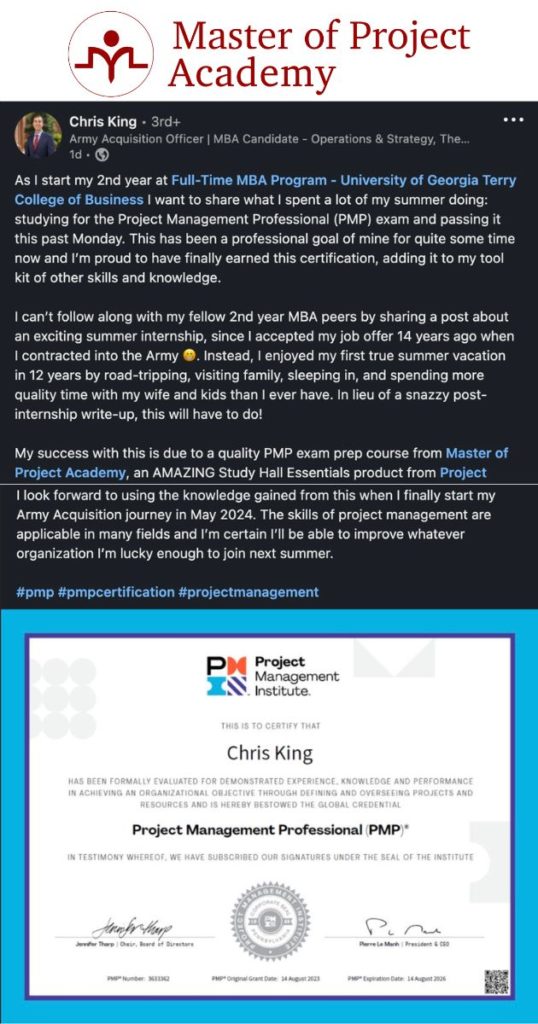
3) Become exceptional at risk management (your disruption superpower)
Disruption punishes teams that “hope for the best.” PMs who win build systems that expect change:
- assumption mapping
- early warning indicators
- risk burn-down
- pre-mortems
- decision logs
You’ll see exactly how to apply these in the risk plan and register below.
2030: The World Belongs to Those Who Build — Projects, Products, Solutions, Systems
4) Treat cybersecurity as a delivery requirement
Security is no longer “someone else’s checklist.” It’s part of the project definition—like budget or schedule.
Even if you don’t work in security, understanding cyber risk raises your value fast—especially in regulated industries.
CTA: Want to lead secure-by-design delivery? Master of Project Academy’s CISSP course online and CISSP certification training can help you develop the security and risk mindset that modern organizations demand.
5) Build influence systems (not just “soft skills”)
In disruption, priorities collide and resources shrink. Your edge comes from repeatable influence systems:
- stakeholder maps
- communication plans by audience
- scope tradeoff negotiation
- escalation paths and decision ownership
- meetings designed to produce decisions (not updates)
Crafting Tailored Project Plans that Deliver Real Business Value (and How AI Can Help)
Brief Risk Management Plan (Practical, Adaptable, and Ready to Use)
Below is a lightweight risk management plan you can drop into almost any project impacted by disruption (AI, cyber, regulation, market volatility, or workforce change).
1) Purpose
Reduce threats and seize opportunities by identifying, analyzing, responding to, and monitoring risks throughout the project lifecycle.
2) Risk Approach and Cadence
- Risk identification: at kickoff, at each major milestone, and when major changes occur
- Risk review: weekly (delivery team) + biweekly/monthly (steering stakeholders)
- Risk triggers: monitored continuously via early warning indicators (EWIs)
- Escalation: defined thresholds based on impact and urgency
3) Roles and Responsibilities
- Project Manager (PM): owns the risk process; maintains the risk register; drives mitigation and escalation
- Risk Owners: accountable for executing response plans for assigned risks
- Sponsor/SteerCo: approves major response plans (budget/scope changes) and accepts residual risk
- Security/Compliance SMEs: consulted for cyber/privacy/regulatory risks
- Team Members: surface new risks and triggers early—no penalties for raising risk
Do You Have Wise Team Members? 5 Traits That Turn Project Chaos Into Calm (and How to Develop Them)
4) Risk Categories (use as a checklist)
- Strategic: alignment, business model, competitive shifts
- Operational: process changes, adoption, training, staffing
- Technology: architecture, integration, AI performance, data quality
- Cybersecurity & Privacy: access control, vendor risk, incident exposure
- Regulatory & Compliance: legal requirements, audits, documentation
- Financial: budget, cost inflation, ROI erosion
- Schedule & Delivery: dependencies, vendor delays, scope creep
- Reputation & Customer: trust, service disruption, PR impact
Embracing Failure: How Project Managers Can Transform Setbacks into Stepping Stones
5) Scoring Method (simple, fast)
- Probability (P): 1–5 (Rare → Almost Certain)
- Impact (I): 1–5 (Negligible → Severe)
- Risk Score: P × I
- Priority Bands:
- 1–6 = Low
- 7–12 = Medium
- 13–25 = High
6) Response Strategies
- Avoid: change plan to eliminate risk
- Mitigate: reduce probability or impact
- Transfer: insurance, vendor contracts, SLAs
- Accept: monitor; prepare contingency if needed
- Exploit/Enhance (opportunities): actively pursue upside risks
7) Early Warning Indicators (EWIs)
Examples you can track:
- stakeholder sentiment dips / increased escalations
- defect rate increases after automation changes
- backlog growth or cycle time spikes
- vendor delivery slippage trends
- security findings increasing, audit gaps widening
- adoption metrics below target (usage, training completion)
What Project Managers Can Learn from a “False Flag” Scenario
8) Reporting
- Weekly: top 5 risks, new risks, closed risks, and risk trend (up/down)
- Steering: high risks, decisions required, budget/scope implications, residual risk acceptance
Risk Register (Disruption-Focused Example You Can Reuse)
Below is a realistic risk register tailored to disruption-era delivery. Adjust the wording to your project and industry.
| ID | Risk Description | Category | P (1–5) | I (1–5) | Score | Early Warning Indicators | Response Strategy | Mitigation / Contingency Actions | Owner | Status |
| R1 | Automation/AI changes reduce role clarity, causing resistance and slowed adoption | Operational | 4 | 4 | 16 | training completion low; negative feedback; rising rework | Mitigate | change mgmt plan; role mapping; pilots; champions network | Change Lead | Open |
| R2 | Data quality issues degrade AI/automation outputs, leading to errors and loss of trust | Technology | 3 | 5 | 15 | error rate spikes; exceptions rising; manual overrides increase | Mitigate | data profiling; validation rules; monitoring; rollback plan | Data Lead | Open |
| R3 | Cybersecurity controls added late trigger rework and schedule slippage | Cyber/Privacy | 3 | 5 | 15 | late security reviews; unresolved findings; vendor gaps | Avoid/Mitigate | security by design; threat modeling; access reviews early | Security SME | Open |
| R4 | Vendor/tooling changes or licensing constraints disrupt delivery roadmap | Delivery/Financial | 3 | 4 | 12 | contract delays; roadmap changes; price increases | Transfer/Mitigate | SLAs; alternative vendors; contract buffers; phased rollout | Vendor Mgr | Open |
| R5 | Regulatory changes introduce new documentation/testing requirements | Compliance | 2 | 5 | 10 | new guidance; audit notes; legal review flags | Mitigate | compliance checkpoints; documentation templates; audit readiness | Compliance Lead | Watch |
| R6 | Key talent attrition (AI/security skills) creates delivery bottlenecks | Talent | 4 | 4 | 16 | resignations; hiring delays; skills gaps | Mitigate | cross-training; succession plan; staffing model; contractors | PM | Open |
| R7 | Scope creep driven by “we can do more with AI” expands complexity beyond capacity | Scope | 4 | 3 | 12 | backlog expansion; unclear requirements; stakeholder adds features | Avoid/Mitigate | strict change control; MVP; outcome metrics; decision gates | PM | Open |
| R8 | Stakeholder misalignment on value metrics leads to conflicting priorities and churn | Strategic | 3 | 4 | 12 | competing KPIs; unclear success definition; escalations | Mitigate | outcome scorecard; governance; decision rights; cadence | Sponsor | Open |
| R9 | Customer experience degrades during transition, harming reputation | Customer | 2 | 5 | 10 | NPS dip; complaint volume rising; downtime events | Mitigate | phased rollout; comms; support surge plan; rollback | Ops Lead | Watch |
| R10 | Opportunity: Automation reduces cycle time significantly if adoption is high | Opportunity | 3 | 4 | 12 | fast pilot results; high usage; low error rate | Exploit | scale plan; invest in training; expand use cases carefully | PM | Active |
How to use this register immediately:
- Pick your top 5 by score
- Assign a real owner (not “the team”)
- Add EWIs you can measure weekly
- Put mitigation actions into the schedule as real tasks (not wishful notes)
Why PMP + CISSP Is a Career Multiplier During Disruption
Disruption rewards PMs who can deliver outcomes and protect trust.
- PMP certification training strengthens your ability to manage scope, time, cost, quality, stakeholders, and risk in complex environments.
- CISSP certification training builds the security and governance fluency that modern programs increasingly require—especially in enterprise, regulated, and tech-heavy projects.
CTA (PMP): If you want a structured, proven approach to leading uncertain projects, Master of Project Academy’s PMP course online can help you build real execution confidence.
CTA (CISSP): If you want to be the PM who can lead secure transformation and speak credibly with security, audit, and leadership, explore Master of Project Academy’s CISSP course online.
FAQs: Key Steps Leaders Should Take Now
1) What is the biggest risk to project success during disruption?
Unmanaged uncertainty. Teams plan as if the environment is stable, then get blindsided by shifting priorities, new constraints, or emerging risks. A living risk register with triggers and weekly reviews is the antidote.
2) What should leaders implement immediately to reduce disruption impact?
- Portfolio triage (reduce work in flight)
- Clear decision rights and escalation paths
- Standard delivery templates (charter, comms plan, risk register)
- Security/compliance checkpoints early
- Training plan for PM capability and cyber awareness
Good vs. Wise Decisions in Project Management: The Subtle Difference That Shapes Outcomes
3) How do we stop scope creep in AI-heavy initiatives?
Define “success” in measurable outcomes, ship an MVP, enforce change control, and require tradeoffs (if something new is added, something else must move).
4) How can leaders reduce burnout during constant change?
Fewer concurrent projects, clear priorities, realistic capacity planning, and investments in skills so teams feel in control—not constantly behind.
5) What is one sign our transformation is at risk?
When status meetings multiply but decisions don’t. That usually means misalignment, unclear ownership, and hidden risks.
6) Which training creates the fastest ROI for disrupted organizations?
PMP-aligned delivery discipline improves throughput and predictability. CISSP-aligned security fluency reduces rework, incidents, and compliance surprises. Together, they raise execution speed without sacrificing trust.
The Bottom Line: Disruption Rewards the Prepared
Disruption doesn’t eliminate project management. It eliminates undisciplined delivery.
The next era rewards Project Managers who can:
- deliver outcomes, not activity
- manage risk with maturity
- communicate with authority
- build trust across business, tech, and security
If you want to become the PM leaders rely on when the stakes rise, commit to the skills that scale your impact.
Next step: Start with Master of Project Academy’s PMP courses to strengthen modern execution mastery—and add credibility in high-stakes environments with Master of Project Academy’s CISSP courses.