The Project Management Professional certification represents a pivotal career milestone. For many, it’s the difference between being considered for senior roles and remaining stuck at mid-level positions. It’s the credential that signals commitment, competence, and professional credibility.
But there’s a dimension to PMP certification that rarely receives attention: the difference between passing on your first attempt versus succeeding after multiple tries. Both paths lead to the same credential—the letters “PMP” after your name remain identical regardless of how many attempts you needed. Yet the paths differ significantly in their career implications.
The First-Time Pass Phenomenon: What 99.6% Really Means for Your PMP Journey
First-time success creates psychological, professional, and economic advantages that compound throughout your career. Understanding these advantages transforms how you approach PMP preparation—from viewing it as an exam to pass into recognizing it as a career accelerator where the method of success matters as much as success itself.
The Psychological Foundation: Confidence Under Pressure
Christina Park sat for the PMP exam twice. She failed her first attempt by a narrow margin—one domain at Target, the rest Above Target. “I was so close,” she recalls. “But close didn’t matter. Failed is failed.”
Three months later, Christina passed on her second attempt. She earned her PMP credential and celebrated the achievement. Yet when asked about the experience years later, she reveals unexpected lasting effects.
“Even now, when I face high-pressure situations—presenting to executives, making critical project decisions, interviewing for new roles—I sometimes feel that flash of doubt. ‘What if I fail like I did on the PMP?’ It’s irrational; I passed eventually. But that first failure planted a seed of self-doubt that occasionally surfaces.”
Contrast this with James Mitchell’s experience. James passed on his first attempt after ten weeks of preparation. “When I saw ‘Congratulations’ on the screen, I felt this surge of validation,” he shares. “I’d prepared systematically, executed under pressure, and succeeded. That experience became a reference point I return to whenever I doubt myself.”
The psychological difference between first-time success and eventual success may seem minor. Both candidates ultimately hold PMP certification. But the internal narrative differs fundamentally.
First-time success creates a success-under-pressure identity. You prepared thoroughly, performed when it mattered, and achieved your goal. This experience builds self-efficacy—the belief that you can accomplish challenging objectives through proper preparation and execution.
Failure-then-success creates a more tentative narrative. Yes, you ultimately succeeded, but only after initial failure. The question “Can I succeed under pressure?” receives a complicated answer: “Sometimes, eventually, if I try enough times.”
This psychological difference, while subtle, influences how you approach subsequent career challenges. Do you enter high-stakes situations with the quiet confidence of someone who succeeds on the first try? Or with the caution of someone who needed multiple attempts?
From Zero to PMP: Five Professionals Who Passed on Their First Attempt
Professional Perception: The Stories We Tell
During a job interview, the hiring manager asks about your PMP certification. This question offers an opportunity to demonstrate your professional approach, preparation methodology, and execution capability.
The first-time passer’s narrative:
“I decided to pursue the PMP to formalize my project management knowledge. I invested in quality preparation, committed ten weeks to systematic study, and passed on my first attempt. The process taught me valuable lessons about structured learning and performing under pressure that I’ve applied throughout my career.”
This narrative positions you as someone who approaches challenges strategically, invests in proper preparation, and executes successfully—exactly the qualities organizations seek in project managers.
The multiple-attempt narrative:
Telling the truth requires acknowledging failed attempts, which introduces complexity. Do you mention the failures and risk raising doubts about your ability to succeed under pressure? Or omit them and hope the topic doesn’t surface?
Neither option provides the clean, confidence-building narrative that first-time success offers.
“I’ve interviewed dozens of PM candidates,” shares Rachel Morrison, a VP of Program Management at a Fortune 500 company. “When candidates mention passing the PMP exam on their first try, it signals preparation quality and execution capability. It’s a small data point, but in competitive hiring situations, these signals matter.”
The professional perception extends beyond hiring:
Project Assignments: When executives select project managers for high-visibility initiatives, they consider track records of success under pressure. First-time certification success contributes to that track record.
Leadership Opportunities: Organizations promote individuals who demonstrate consistent achievement. A pattern of first-time success across professional challenges—including certification—builds a reputation for reliability and competence.
Networking and Professional Community: Within PMI chapters and professional networks, first-time pass stories create connections with other high-achievers who similarly invested in quality preparation and succeeded immediately.
Enroll in Master of Project Academy’s PMP courses to pass your PMP exam on the first attempt:
The Efficiency Advantage: Time as Your Most Valuable Asset
Marcus Williams invested $200 in a discount PMP preparation course. After failing his first attempt, he spent $275 on the retake and another $300 on supplemental materials. Four months after his initial exam, he finally passed.
Total financial cost: $775 (versus $405 for first-time success)
But the financial calculation misses the larger cost: four months of his professional life.
The Economics of First-Time Success: What a 99.6% Pass Rate Really Saves You
“Those four months felt like purgatory,” Marcus reflects. “I couldn’t fully focus on my career because the PMP failure hung over me. I declined a stretch project assignment because I needed evenings to study for the retake. I avoided networking events because I felt like an imposter—a project manager who couldn’t pass the PM certification.”
The opportunity cost of those four months extended beyond the declined project. That assignment went to a colleague who delivered it successfully and subsequently received a promotion Marcus had been positioning himself for.
“My $200 savings on preparation cost me a promotion, maybe eighteen months of career progression, and tens of thousands in earning potential,” Marcus calculates. “Worst financial decision I’ve made professionally.”
Time lost to exam retakes and extended preparation can never be recovered. Every month spent preparing for a retake is a month not spent:
- Building expertise in emerging project management areas (AI integration, sustainable PM practices, advanced agile frameworks)
- Pursuing additional certifications that complement the PMP
- Taking on high-visibility projects that accelerate career progression
- Developing leadership capabilities through challenging assignments
- Building professional networks that create future opportunities
First-time success protects your most valuable professional asset: time. It allows you to move forward immediately rather than remaining stuck in preparation purgatory.
The Momentum Effect: Success Breeds Success
Sarah Rodriguez passed her PMP on the first attempt in March. By June, she’d been promoted to senior project manager. By December, she was leading a strategic initiative reporting directly to the CFO. Eighteen months later, she became the company’s youngest-ever program manager.
“The PMP was the catalyst,” Sarah explains. “But it wasn’t just the credential—it was the confidence and momentum that came from succeeding on the first try. I felt unstoppable. That mindset made me bold in pursuing opportunities I might have hesitated to chase otherwise.”
Success creates psychological and professional momentum. First-time PMP success establishes a pattern: you set ambitious goals, prepare thoroughly, and achieve them. This pattern repeats, each success building confidence for the next challenge.
6 Reasons 99.1% of Our Students Pass the PMP Exam on the First Attempt (and How You Can Too)
The momentum manifests in several ways:
Increased Ambition: First-time success increases your willingness to pursue stretch goals. You’ve proven you can achieve difficult objectives, making previously intimidating challenges seem achievable.
Enhanced Credibility: Colleagues and leaders notice patterns of success. A track record of first-time achievement creates a reputation as someone who delivers reliably, increasing opportunities for impactful assignments.
Accelerated Learning: Success builds learning confidence. You’re more willing to tackle unfamiliar domains because you trust your ability to master new material—a confidence developed through experiences like first-time PMP success.
Network Effects: High achievers attract other high achievers. First-time PMP success connects you with communities of individuals who similarly value excellence and thorough preparation, creating professional networks that accelerate career growth.
This momentum compounds. Each success makes the next more likely, creating an upward trajectory that shapes your entire career arc.
The Investment Mindset: Long-Term Thinking
Michael Chen chose between two PMP preparation options:
Option A: $150 course with decent reviews and 65% reported pass rate
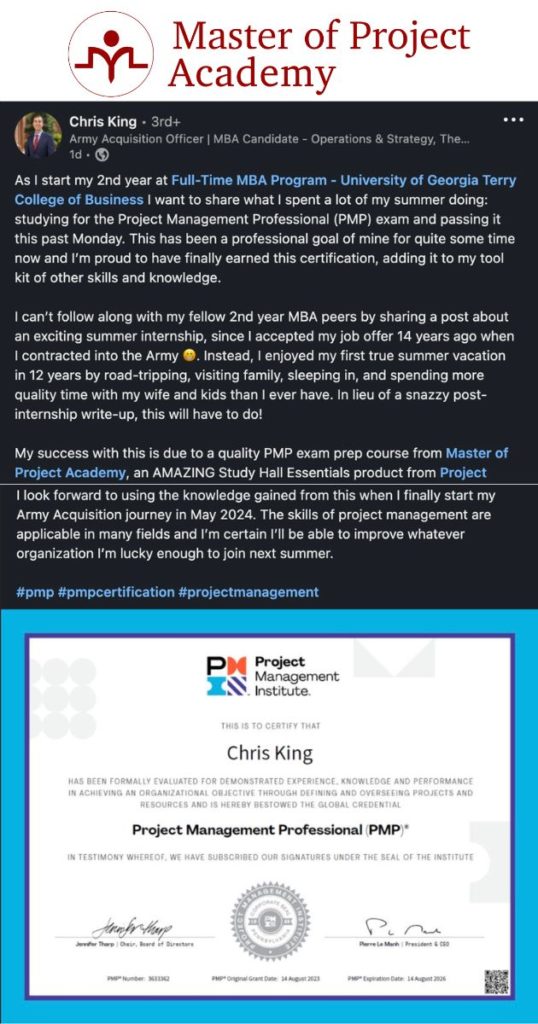
Option B: $500 Master of Project Academy course with 99.6% first-time pass rate
Michael chose Option A, rationalizing that all courses teach the same content and $350 in savings was significant.
Three months and two failed attempts later, Michael had spent $700 (course + two retakes + supplemental materials) and still hadn’t achieved certification. He finally invested in Master of Project Academy and passed on his next attempt.
Total cost: $1,200 and four months
Option B cost: $500 and ten weeks
“I was being penny wise and pound foolish,” Michael reflects. “I optimized for initial cost rather than total outcome. That short-term thinking cost me dearly.”
The Specialist’s Advantage: What Depth of Expertise Actually Means for Your PMP Success
Michael’s experience illustrates a broader principle: first-time success requires investment mindset over expense mindset.
Expense mindset asks: “What’s the cheapest way to pass the PMP exam?”
This thinking leads to:
- Selecting low-cost preparation resources
- Minimizing time investment in studying
- Viewing preparation as an expense to minimize
Investment mindset asks: “What preparation approach maximizes my probability of first-time success and sets the foundation for career advancement?”
This thinking leads to:
- Selecting quality preparation designed for first-time success
- Investing adequate time in thorough preparation
- Viewing preparation as investment in career trajectory
The expense mindset optimizes locally (minimize immediate costs) at the expense of global optimization (maximize career outcomes). The investment mindset recognizes that money and time invested in quality preparation return multiples through first-time success and its compounding advantages.
The Credential Value Perception
Here’s an uncomfortable truth about professional certifications: the credential’s value partially depends on how you achieved it.
Two candidates hold identical PMP certifications. Candidate A passed after three attempts over nine months. Candidate B passed on the first try after systematic preparation. The certification is legally and officially identical. Yet the achievement they represent differs.
This distinction matters in competitive professional contexts. When multiple candidates hold the same credentials, hiring managers and executives look for differentiating factors. The path to certification—particularly whether it involved first-time success or multiple attempts—provides signal about:
Preparation Quality: First-time success suggests you invest in proper preparation rather than taking shortcuts.
Learning Capability: It indicates you can master complex material systematically and efficiently.
Pressure Performance: It demonstrates you execute successfully in high-stakes situations.
Professional Judgment: It shows you make sound decisions about resource investment (choosing quality preparation over bargain alternatives).
While these interpretations may seem harsh toward candidates who needed multiple attempts, they reflect real hiring and promotion decision-making. In competitive environments, every signal matters.
First-time success maximizes your certification’s career value by eliminating any questions about your path to achievement.
Beyond Certification: How Specialist Training Develops Career-Long PM Competency
The Compounding Career Impact: A Ten-Year View
Consider the ten-year career trajectories of two project managers with identical starting points except PMP certification paths:
Manager A: First-Time PMP Success
- Year 1: Passes PMP on first attempt, receives 20% salary increase to $108,000
- Year 2: Promoted to Senior PM ($130,000) based on strong performance and credential
- Year 4: Becomes Program Manager ($160,000)
- Year 6: Appointed PMO Director ($195,000)
- Year 9: Promoted to VP of Program Management ($240,000)
- 10-Year Total Earnings: $1,847,000
Manager B: PMP After Two Failed Attempts
- Year 1: Fails PMP twice, passes on third attempt seven months later, minimal immediate salary impact ($92,000 for 7 months, $110,000 for 5 months)
- Year 2: Senior PM promotion delayed due to missed windows ($118,000)
- Year 4: Eventually promoted to Senior PM ($140,000)
- Year 7: Becomes Program Manager ($172,000)
- Year 9: Still at Program Manager level ($185,000)
- 10-Year Total Earnings: $1,562,000
Career Earnings Difference: $285,000 over ten years
And Manager A remains one level ahead in the organizational hierarchy, positioned for C-suite roles Manager B hasn’t yet accessed.
This projection makes conservative assumptions. In reality, the compounding effects of momentum, confidence, network development, and opportunity access could create even larger divergences.
The Testimonial Truth: What ‘Passed on First Try’ Really Means
Your First-Attempt Advantage Starts Now
The choice to pursue first-time PMP success isn’t just about passing an exam efficiently. It’s about establishing a pattern of excellence that compounds throughout your career.
It’s about building the psychological foundation of someone who succeeds under pressure. About creating professional narratives that open doors. About protecting your time for career advancement rather than exam retakes. About generating momentum that accelerates your entire trajectory.
The question isn’t whether first-time success matters—the economic, professional, and psychological evidence clearly demonstrates it does. The question is whether you’re willing to prepare using methodology specifically designed to achieve that outcome.
Ready to capture the first-attempt advantage? Explore Master of Project Academy’s PMP Certification Training and discover why specialized preparation designed for first-time success delivers career returns far beyond exam passage. Your compounding career advantages begin with choosing preparation built for immediate success.
Frequently Asked Questions
Q: Does it really matter if I pass on the first attempt versus the second or third?
A: While the credential remains identical, the path to achieving it carries professional and psychological implications. First-time success demonstrates preparation quality, learning capability, and execution under pressure—signals that matter in competitive career contexts. Additionally, time saved through first-time success can be invested in career-advancing activities.
Q: How should I explain PMP certification in interviews and professional contexts?
A: If you passed on the first attempt, mentioning this frames you as someone who prepares thoroughly and executes successfully under pressure. If you needed multiple attempts, focus on what you learned through the process and how the certification has impacted your project management capabilities. Avoid dwelling on failed attempts; emphasize the knowledge gained and how you’ve applied it.
Q: What if I’ve already failed the PMP exam once—is it too late for “first-time success” advantages?
A: While you can’t change past attempts, you can still achieve success on your next attempt using methodology designed for that outcome. Many students who failed with other platforms pass successfully using Master of Project Academy‘s approach. The key is learning from the first experience and investing in preparation specifically designed to address why the first attempt didn’t succeed.
Your Complete Roadmap: Combining Burn Rates with PMP Certification for Career Acceleration
Q: How do I maximize the career value of my PMP certification once I’ve passed?
A: Update your resume, LinkedIn profile, and professional materials immediately. Inform your manager and HR about the achievement. Pursue projects that leverage your enhanced project management capabilities. Consider additional certifications that complement the PMP. Join PMI chapters and professional communities. Most importantly, apply what you learned preparing for the exam to create measurable project success that justifies promotion and advancement.
Q: Is investing in expensive preparation really worth it for first-time success?
A: Calculate your personal ROI by considering retake fees, delayed salary increases, postponed promotions, and opportunity costs of extended preparation time. For most professionals, premium preparation costs $300-500 but prevents $1,000+ in retake fees and $5,000-20,000+ in delayed salary increases. The investment typically returns 1000%+ in first-year value alone, not including compounding career effects.