When war erupts — suddenly, without warning, across complex geopolitical terrain — the world watches leaders make decisions that will define history. Billions of dollars in resources mobilize overnight. Coalitions of stakeholders with competing agendas must align. Communication systems are tested to their breaking point. Resources dry up. Risk registers written in peacetime become obsolete in hours.
If that sounds uncomfortably familiar, it should.
The outbreak of war is, at its core, a compressed and ultra-high-stakes project management scenario. And for the modern project manager — whether you are leading a technology transformation, managing a construction megaproject, or steering organizational change — the strategic lessons forged in the crucible of conflict are not merely academic. They are immediately actionable.
This post draws directly on how military leaders have historically responded to the outbreak of conflict and translates each lesson into a framework that certified project managers can apply on day one. If you are preparing for your PMP certification or looking to elevate your project leadership to the highest level, these insights will sharpen every skill the PMI Examination Content Outline (ECO) demands.
| ⚡ Key Insight
Wars are not won in the battlefield alone — they are won or lost in the planning room, the supply chain, the command structure, and the morale of the team. Every one of those arenas has a direct project management parallel. |
Why Is War the Ultimate Stress Test for Project Management Skills?
Most project managers operate in conditions of relative stability — shifting priorities, yes, but rarely existential uncertainty. The outbreak of war removes that comfort entirely. It is precisely this removal of predictability that makes wartime leadership such a potent case study.
According to the Project Management Institute (PMI), approximately 70% of projects fail to meet their original objectives in time, budget, or scope. The most commonly cited causes mirror the very conditions that define the opening of a military conflict:
- Poorly defined scope and rapidly changing requirements
- Communication breakdowns across stakeholder groups
- Underestimated resource demands and logistics failures
- Risk that was identified but not adequately planned for
- Leadership that could not adapt to ambiguity
These are not coincidental overlaps. They are structural features of any large-scale, high-stakes endeavor. The project manager who understands how great military leaders have navigated them gains a profound and transferable playbook.
| 70% | of projects fail to fully meet original scope, time, or budget objectives (PMI Pulse of the Profession) |
| $48T | in global project spending annually — with roughly $1 in every $6 wasted due to poor project performance |
| 99.6% | first-attempt PMP exam pass rate at Master of Project Academy — vs. industry average of ~55% |
| 500K+ | students trained across 180+ countries by Master of Project Academy |
What Does the Fog of War Teach Project Managers About Decision-Making Under Uncertainty?
Prussian military theorist Carl von Clausewitz coined the phrase ‘the fog of war’ to describe the fundamental uncertainty commanders face in battle: incomplete information, unreliable communications, and an adversarial environment that is actively trying to deceive you.
Project managers face their own fog — incomplete requirements, shifting stakeholder priorities, hidden technical debt, and vendors who underdeliver. The critical leadership question is identical: how do you make high-quality decisions when you do not have complete information?
The Military Answer — and the PMP Answer — Are the Same
- Assume and document your assumptions explicitly
- Create decision gates so you can pause, re-evaluate, and pivot at defined intervals
- Invest in intelligence gathering (in projects: requirements elicitation, stakeholder interviews, and prototype testing) before committing resources
- Train your team to escalate anomalies early rather than absorbing uncertainty silently
| ⚡ PMP Application
The PMBOK Guide’s iterative planning approach — rolling wave planning — is the project manager’s direct equivalent of military reconnaissance. You plan as far as your intelligence allows, then reconnoiter forward and update the plan. Predictive and adaptive (agile) hybrid frameworks formalize exactly this discipline. |
The worst decision in a crisis — military or professional — is paralysis. Leaders who wait for certainty that will never come lose the initiative. In project management, this manifests as scope creep tolerated too long, risks that were ‘being monitored’ without trigger thresholds, and issues left on the log without owners.
The discipline of calibrated decision-making under uncertainty is one of the highest-order competencies tested on the PMP exam and one of the skills most consistently separating high-performing project leaders from average ones.
| Ready to Master Decision-Making Under Pressure?
Master of Project Academy’s PMP exam preparation course covers risk management, adaptive planning, and stakeholder leadership in depth — with a 99.6% first-attempt pass rate. → Explore the PMP Certification Course → masterofproject.com |
How Does Risk Management in War Translate to Project Risk Management?
No general has ever gone to war without a risk plan. The difference between generals who succeed and those who do not is rarely access to the same information — it is the quality of the risk thinking they applied before the first shot was fired.
History’s greatest military blunders are almost universally characterized by one of three risk management failures:
- Risks were identified but probability or impact was radically underestimated (the Maginot Line, built to fight the last war)
- Risks were identified but trigger thresholds were not defined — leaders kept waiting for ‘one more signal’ before acting
- Risk responses were planned but resources for those responses were not pre-positioned
Project managers repeat these exact mistakes every day. The risk register becomes a document to satisfy an audit rather than a living tool for navigating uncertainty.
What Best-in-Class Military and Project Risk Management Share
- is continuous, not a one-time workshop exercise: Threat identification
- is regularly revised as the environment changes: Probability and impact scoring
- are assigned and held accountable — risks without owners are not managed risks: Risk owners
- are planned for — the response itself can create new threats: Secondary and residual risks
- (contingency and management) are budgeted explicitly, not hoped for: Risk reserves
| ⚡ Extractable Insight
The military concept of ‘branches and sequels’ — planning for multiple possible future states — is the direct ancestor of scenario planning in project risk management. Every major project should have documented responses for its top three to five threat scenarios before execution begins. |
The PMP exam tests your ability to distinguish between threats, opportunities, risk responses (avoid, mitigate, transfer, accept, escalate), and how to apply them situationally. This is not academic trivia — it is the exact thinking framework that separates a reactive project manager from a proactive one.
What Can Project Managers Learn from Military Coalition Management and Stakeholder Dynamics?
No modern military conflict is fought by a single actor. Allies must be coordinated, each with their own command structure, risk appetite, communication norms, and political constraints. The general who can hold a coalition together under pressure while still executing a coherent strategy is rare — and extraordinarily valuable.
Every project manager who has worked in a matrix organization, across geographies, or with external vendors and clients knows this experience intimately. Your coalition is your stakeholder ecosystem, and managing it is among the most complex and consequential work you do.
Mastering Multi-Project Management: Lessons from Multi-Front Warfare
Five Stakeholder Management Lessons from Military Coalition Command
- — allied forces fragment when they lose clarity about what they are collectively trying to achieve. In projects, the project charter is your coalition agreement. It must be explicit, agreed, and visible. Clarity of shared objective is non-negotiable
- — military coalitions use defined communication channels, briefing cadences, and information hierarchies. Status meetings, escalation protocols, and written communication plans exist for the same reason. Communication must be structured, not ad hoc
- — trust in a coalition erodes with every missed commitment. In projects, if you say you will deliver something by Friday, deliver it by Friday or communicate proactively. Honor your commitments
- — effective diplomacy (and effective stakeholder management) requires understanding what each party actually needs versus what they say they want. Know each stakeholder’s interests — not just their stated position
- — allies defect. Sponsors lose interest. Key stakeholders leave organizations. The PMP-aligned project manager has a stakeholder engagement plan that anticipates changes in engagement level and has responses ready. Plan for coalition fracture as a risk
| ⚡ Key Insight
The PMI Talent Triangle places ‘leadership’ and ‘strategic and business management’ alongside ‘technical project management’ for good reason. The ability to build and hold a coalition under pressure is as important as knowing how to build a WBS. |
How Does Military Communication Discipline Apply to Project Management?
History is littered with battles lost not because of insufficient resources or flawed strategy, but because a message was garbled, delayed, or never sent. The charge of the Light Brigade at Balaclava. The failed coordination at the Battle of Gallipoli. Communication breakdown as the proximate cause of catastrophe is a recurring theme in military history.
In projects, the stakes are lower but the mechanism is identical. The PMI Pulse of the Profession consistently identifies poor communication as one of the top causes of project failure. And yet most project teams treat communication as an afterthought — something that happens around the actual work.
Project Communication: Empowering Teams vs. Undermining Their Value
What Wartime Command Structures Teach About Project Communication
- — military orders are designed to convey the maximum information in the minimum words. Project status reports, meeting agendas, and stakeholder updates should follow the same principle. Brevity and precision are virtues
- — communication planning is about designing information flows deliberately, not assuming they will happen organically. The right information must reach the right person at the right time
- — in combat communications, acknowledged receipt of an order is mandatory. In projects, the communication plan should specify feedback loops that confirm critical messages were received and understood. Acknowledge receipt
- — wartime commanders are overwhelmed with information. The skill is distinguishing the signal (actionable intelligence) from the noise. Project managers must curate dashboards and reports that surface what matters. Separate signal from noise
- — when a project enters turbulence, the instinct of many PMs is to go quiet until they have answers. The military model is opposite: increase the frequency and maintain the discipline. Crisis mode demands increased communication frequency
| ⚡ PMP Application
The PMP exam’s communications management knowledge area covers communication planning, management, monitoring, and reporting. These are not bureaucratic obligations — they are the project manager’s command and control infrastructure. Treat them accordingly. |
| Build Your Command-Level Communication Skills
Master of Project Academy’s PMP training includes a complete module on communications management — one of the most consistently tested domains on the PMP exam. |
What Does Military Logistics Teach Project Managers About Resource Management?
Napoleon Bonaparte reportedly said that an army marches on its stomach. What he meant was that all strategic brilliance collapses without operational logistics. You can have the finest soldiers, the most inspired battle plan, and the most favorable terrain — and lose because your supply chain failed.
Project managers have a direct corollary: you can have the most talented team, the clearest scope, and the most engaged sponsor — and fail because your resource management was inadequate.
The Logistics Lessons That Transfer Directly
- — acquiring the right people, tools, and vendor capacity after the project has started is a reactive posture that almost always creates delays and cost overruns. Resource planning must precede execution, not run concurrently with it
- — in military terms, a unit that cannot advance because another unit has not yet secured its flank is experiencing a dependency failure. In projects, an untracked dependency is a schedule risk waiting to materialize. Dependencies are logistics
- — supply chain disruptions (vendors who underdeliver, materials delayed, contracts poorly structured) are among the least-glamorous but most impactful project risks. Military logistics planners treat supplier reliability as a first-class threat. Procurement risk is project risk
- — military commanders maintain reserve forces even when the front line demands reinforcement. Project managers should maintain schedule and cost contingency reserves with defined release criteria. Never strip reserves to zero
- — the final delivery — user acceptance, go-live, handoff to operations — is where many projects fail despite months of successful execution. Plan the last mile with the same rigor as the first. Last-mile logistics often determines outcomes
| ⚡ Extractable Insight
Resource management, procurement management, and schedule management are three separate but deeply interconnected PMBOK knowledge areas. The PMP exam tests your ability to navigate the interdependencies between them — exactly as military logistics commanders must. |
Chess Strategies: Mastering the Art of Project Management
How Does Military Leadership Under Pressure Translate to Project Team Management?
Military history demonstrates repeatedly that the difference between an army that holds and one that collapses is rarely equipment — it is morale, unit cohesion, and trust in leadership. The same is true of project teams.
A project in crisis — behind schedule, over budget, under scrutiny from executives — creates the same psychological pressures on a team that combat creates on soldiers. How the project manager responds to that pressure determines whether the team rises or fractures.
Never Let a Good Crisis Go to Waste: Turning Setbacks into Opportunities for Growth
What High-Performing Military Leaders Do — and What Great Project Managers Mirror
- — leaders who disappear when conditions are worst destroy trust. Project managers who engage directly with the team during a crunch communicate that the challenge is shared. They are present and visible during the hardest moments
- — micromanagement in combat is fatal. In projects, it is merely corrosive. Provide clarity of objective and constraints, then lead by exception. They give the team a clear mission, then trust them to execute
- — a good commanding officer shields the unit from irrelevant political distractions so soldiers can focus on the mission. A great project manager does the same. They protect the team from unnecessary organizational noise
- — this is the single fastest builder of trust and the single most cited quality in post-project team retrospectives. They take responsibility for failure and give credit for success
- — leaders who maintain composure, intellectual rigor, and ethical standards under pressure create teams that do the same. They model the behavior they expect
Forged in Fire: Why Adversity Is the Catalyst for Extraordinary Project Leadership
| ⚡ Key Insight
PMI’s Agile Practice Guide and the latest PMP Examination Content Outline place significant emphasis on servant leadership, team empowerment, and emotional intelligence — because decades of research and centuries of military history agree: those qualities drive performance under pressure. |
What Does Wartime Strategic Planning Teach About the Project Management Plan?
Military strategists distinguish between strategy (what you are trying to achieve and why), operational art (how you organize and sequence forces to achieve strategic objectives), and tactics (the specific actions taken in the moment). This three-level model has a direct analog in project management.
- = the project charter and business case — why this project exists and what success looks like for the organization: Strategy
- = the project management plan — how all the components (scope, schedule, cost, quality, risk, communication, resources, procurement, stakeholder engagement) are integrated and sequenced: Operational art
- = the day-to-day management of work packages, sprint execution, issue resolution, and change requests: Tactics
Where project managers most commonly fail is at the operational level — the integration of planning components into a coherent, internally consistent project management plan. Military commanders who fail at the operational level — even with brilliant strategy and skillful tactics — lose campaigns.
What the Best Military Planners Do That the Best Project Managers Do
- They plan for multiple scenarios — not just the most likely one
- They define clear decision points (gates) where the plan is formally reassessed
- They ensure all components of the plan are integrated and do not contradict each other
- They conduct a structured pre-mortem — assuming failure and asking why — before execution begins
- They create a living plan, not a static document — updated as intelligence improves
| ⚡ PMP Application
Integration management — specifically developing, executing, monitoring, and controlling the project management plan — is the highest-order knowledge area in the PMBOK Guide because it encompasses all others. It is also among the most heavily weighted domains on the PMP exam. Mastery here separates project managers from project leaders. |
What Project Managers Can Learn from a “False Flag” Scenario
What Does the Outbreak of War Teach About Scope Control and Change Management?
Military historians use the term ‘mission creep’ to describe the phenomenon by which a military operation gradually expands beyond its original defined objectives — consuming resources, extending timelines, and ultimately threatening the entire campaign.
Mission creep entered the project management lexicon as ‘scope creep’ — and it is one of the most reliably cited causes of project failure globally. The parallel is not accidental. The underlying dynamic is identical in both contexts.
Why Mission Creep (Scope Creep) Is So Dangerous
- It is incremental and therefore invisible until it is catastrophic
- Each individual expansion seems reasonable — it is only in aggregate that the damage becomes clear
- It typically occurs without formal authorization or resource adjustment
- It erodes team morale because workload increases without corresponding recognition or adjustment
The Military and Project Management Response
- Formally define and baseline the objective (scope) before execution begins
- Establish a formal change control process — no scope change without authorization, impact assessment, and resource adjustment
- Make the change control board (CCB) a real governance mechanism, not a rubber stamp
- Track and report cumulative scope change — individual changes may appear minor; cumulative change tells the true story
| ⚡ Extractable Insight
The PMBOK Guide’s scope management knowledge area and the Agile practice of the product backlog governed by a product owner serve the same function as a military commander’s clearly defined and defended operational objective. Control the scope or the scope controls you. |
| Master Every Domain Tested on the PMP Exam
Master of Project Academy’s PMP certification training covers all domains of the PMI ECO — including scope control, change management, risk, and integration — with real-world case studies and a proven 99.6% pass rate. |
What Are the Key Project Management Lessons from the Outbreak of War? (Summary)
The following extractable insights synthesize the core lessons from this analysis. Each maps directly to a knowledge area or competency domain within the PMP Examination Content Outline.
- No plan survives first contact — build adaptive, rolling-wave plans with defined revision gates
- Intelligence failures are project failures — invest in requirements elicitation, stakeholder analysis, and honest status reporting
- Risk management must be continuous, owner-assigned, and integrated with execution — not a static document
- Stakeholder management requires understanding interests, not just positions — build your coalition before you need it
- Communication planning is command infrastructure — structure it deliberately, increase frequency in crisis
- Logistics (resource, procurement, dependency management) determines outcomes as much as strategy does
- Team morale is a project resource — protect it, measure it, and invest in it
- Scope creep is mission creep — enforce change control as a non-negotiable governance discipline
- Decision-making under uncertainty is a learnable skill — the pre-mortem, assumption documentation, and calibrated probability thinking are the tools
- Integration management is the highest-order discipline — strategy without operational coherence fails
Frequently Asked Questions: What Leaders Should Do When High-Stakes Projects Begin
Q: What is the first thing a project manager should do when a project enters a crisis?
A: Stabilize the information environment first. Before making any strategic decisions, ensure you have an accurate, verified picture of current status — schedule, cost, scope, resources, and risk. Crisis decisions made on bad data compound the crisis. This mirrors the military principle of establishing situational awareness before committing forces.
Q: How should a project manager handle a major unplanned scope change or external disruption?
A: Invoke formal change control immediately. Assess the impact across all project constraints — schedule, budget, resources, quality, and risk. Communicate the situation and the options to the project sponsor and key stakeholders before making a unilateral decision. Document all decisions and their rationale. In military terms: report up the chain of command, assess the operational impact, and do not act beyond your authorization.
How to Have Uncomfortable Conversations at Work (and Turn Them Into Career Fuel)
Q: What should a project manager do when key stakeholders are in conflict?
A: Surface the conflict explicitly rather than hoping it resolves. Identify the underlying interests of each party (as distinct from their stated positions). Facilitate structured dialogue focused on shared project objectives. Escalate to the sponsor when stakeholder conflict cannot be resolved at the project level. Unresolved stakeholder conflict is one of the most reliable predictors of project failure.
Q: How do the best project managers make good decisions when they do not have complete information?
A: They document their assumptions explicitly, set clear trigger thresholds for revisiting decisions, build in decision gates at defined intervals, and use probabilistic risk thinking rather than binary certainty/uncertainty framing. The goal is not to eliminate uncertainty — it is to make calibrated, transparent decisions that can be updated as information improves.
Q: What is the most common reason experienced project managers fail in high-pressure situations?
A: Reverting to reactive, tactical management when strategic thinking is most needed. Under pressure, many PMs become consumed by urgent tasks and lose sight of the project objectives, stakeholder landscape, and risk picture. The most resilient project leaders deliberately protect time for strategic thinking even — especially — during turbulent periods.
When Project Leaders Should Use the WOOP Method?
Q: How does the PMP certification help project managers handle real-world crises?
A: The PMP certification develops a structured, integrated, and situationally adaptive framework for project leadership. It does not teach you what to do in every situation — it teaches you how to think about any situation. The domains of risk management, integration management, stakeholder engagement, and adaptive versus predictive planning are specifically designed to equip project managers for uncertainty and complexity.
Q: How long does it take to earn a PMP certification?
A: The timeline varies by individual, but most candidates with the required experience (36 or 60 months of project leadership experience depending on education level) can prepare for and pass the PMP exam in 8 to 12 weeks of focused study. Master of Project Academy’s course is structured to prepare candidates in this timeframe with the highest first-attempt pass rate in the industry.
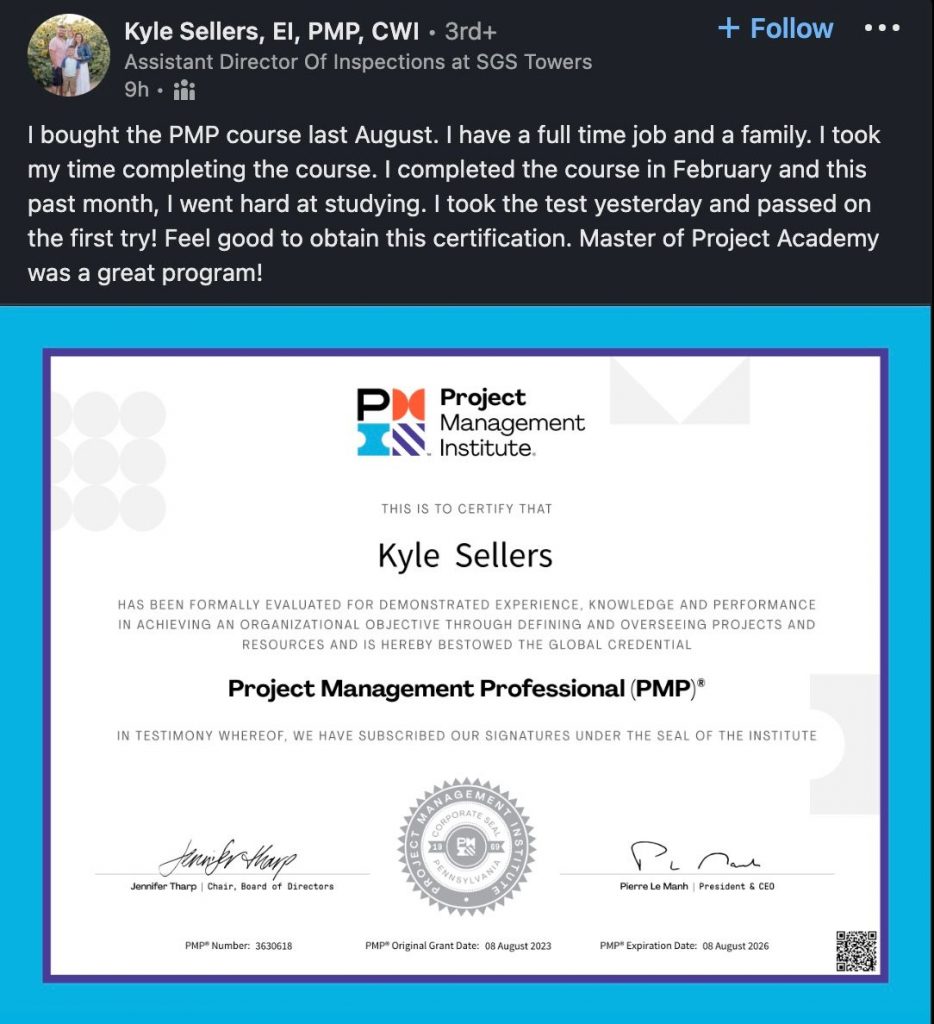
From Zero to PMP: Five Professionals Who Passed on Their First Attempt
Q: Is the PMP certification worth it for experienced project managers?
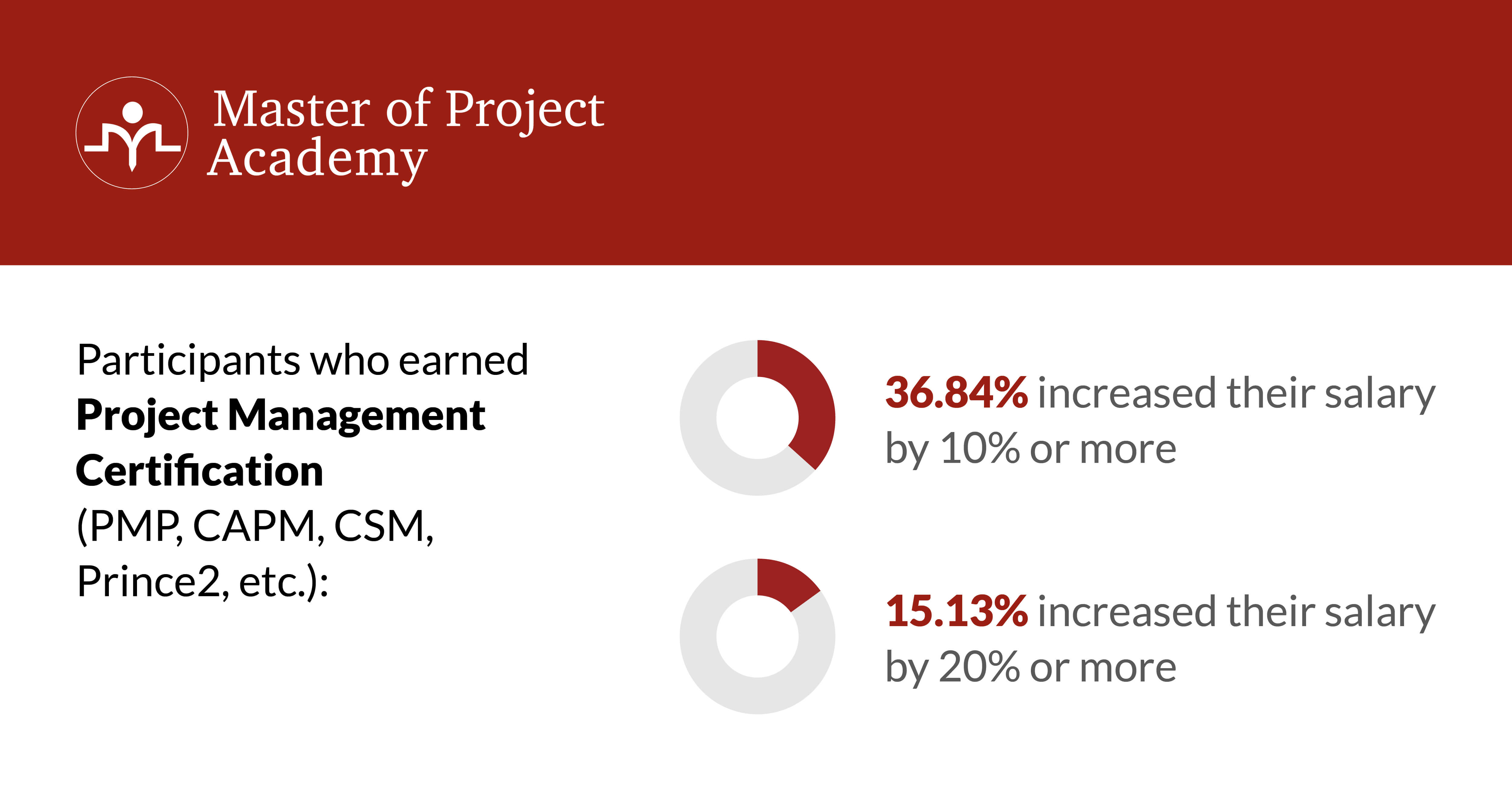
A: The data consistently says yes. PMI’s Earning Power salary survey shows PMP-certified project managers earn a median salary premium of 33% higher than their non-certified peers globally. Beyond compensation, the PMP credential signals a verified level of knowledge, experience, and commitment that commands respect from sponsors, clients, and executive stakeholders.
Are You Ready to Lead Like a Seasoned Commander on Your Next Project?
The project managers who perform at the highest level — under pressure, in complexity, across organizations — share a common foundation: a rigorous, integrated understanding of how projects work, how people behave, and how to make good decisions when certainty is scarce.
That foundation is exactly what the Project Management Professional (PMP) certification is designed to build. And it is exactly what Master of Project Academy has been delivering to over 500,000 project professionals across 180+ countries, with a 99.6% first-attempt PMP exam pass rate that has no peer in the industry.
Whether you are preparing for the PMP exam for the first time, renewing your PDUs, or building the skills of your entire project management team, Master of Project Academy offers the most comprehensive, practitioner-designed, and results-proven training available.
| 🎯 Enroll in Master of Project Academy’s PMP Certification Course Today
Join 500,000+ project professionals worldwide. Benefit from our 99.6% first-attempt pass rate, expert instruction, and lifetime access to the most comprehensive PMP prep course on the market. Enterprise packages available for teams and corporate training needs. |