Coordinators, analysts, and team leads running projects nobody gave you the title for: the people who brought Apollo 13 home had no authority over anyone in the capsule. Neither did the two divers who got thirteen people out of a flooded cave in Thailand. Authority was never the requirement. It still isn’t.
This is the last post in our Elite Teams series, and it’s the one written for the reader who has been doing the work without the job. Every elite team in the series ran on the same thing: not rank, but the ability to get people who don’t report to you to do what the mission needs. Project managers have a name for that skill. PMI tests it. And there’s a certification that lets you prove it before anyone hands you a title.
Read the previous posts about elite teams:
- The One Trait Every Elite Team Shares (and Most Project Teams Don’t)
- Elite Teams Are Small and Fast: What Skunk Works and a Vaccine Taught Us About Agile Project Management
- Elite Teams Adopt the Tool First: AI in Project Management Without Losing Your Judgment
- Elite Teams Over-Train Before the Mission: How to Prepare for the New PMP® Exam
The room in Houston
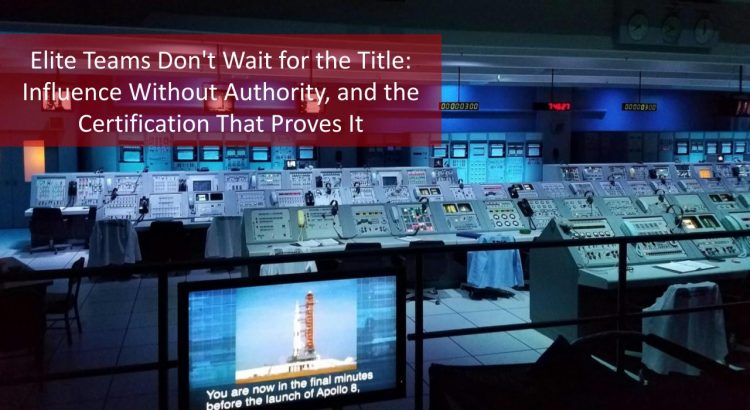
When Apollo 13’s oxygen tank exploded on April 13, 1970, the person responsible for getting three astronauts home was a flight director named Gene Kranz. He was 36. The controllers on his team were mostly in their twenties. And here is the detail that matters: Kranz could not order the astronauts to do anything. The crew belonged to the astronaut office, a separate chain of command. He couldn’t order the engineers at Grumman, who built the lunar module the crew was now using as a lifeboat, or the engineers at North American, who built the crippled command module. They were contractors.
What the flight director had was a headset, a room full of people who trusted him because he’d been in the simulator with them for years, and a way of asking for things that made it clear exactly what was needed and by when. Over four days, that was enough to get engineers from competing companies working the same problem, to get a crew of test pilots to follow instructions from a voice on the ground, and to invent, on the fly, a procedure to fit a square carbon-dioxide filter into a round socket using plastic bags, cardboard, and duct tape from the spacecraft’s own inventory. The team that designed that adapter in Houston had no authority over anyone either. They had a problem and a deadline.
The crew splashed down on April 17. Nobody in the story pulled rank, because nobody had any to pull.
The two divers
In the summer of 2018, the twelve boys and their coach trapped in Thailand’s Tham Luang cave were surrounded by people with authority. The Thai Navy, the provincial governor, the national government, and a thousand volunteers were on site within days. What none of them had was the specific skill of diving several kilometers through a flooded cave in zero visibility.
The two men who did have it were Rick Stanton, a retired British firefighter, and John Volanthen, an IT consultant. They were volunteers with a hobbyist cave-rescue organization, flown in at the request of a British caver who happened to know the cave. They had no official role. They found the boys on July 2. They then shaped the extraction plan, brought in an Australian anesthetist to make the sedation possible, and did the dives themselves. The people with authority made the decision to proceed. The people with the skill made the decision possible.
In a real crisis, the org chart yields to whoever has done the work. Most projects aren’t crises. But the pattern holds at lower stakes: the person who knows the schedule best, has thought hardest about the risks, and asks for things clearly ends up running the project, whatever it says on their badge.
Never Let a Good Crisis Go to Waste: Turning Setbacks into Opportunities for Growth
The room at Pixar
Pixar runs a meeting called the Braintrust. A film in progress is screened to a group of the studio’s most experienced directors and story people, who tell the director exactly what isn’t working. The Braintrust has no authority. It can’t order a single change. The director decides what to do with the notes. The meeting works because everyone in it wants the film to be good and nobody in it can force anything. Take the authority out of the room and what’s left is candor, and candor turns out to be enough.
Authority is granted. Influence is earned. Elite teams run on the second one, and so does every project manager who’s ever had to get a vendor, a stakeholder, or a peer to move without being able to make them.
Influence without authority: the four levers
The PMP® exam‘s People domain is largely a test of this skill, because most project managers have less formal authority than their responsibilities imply. The team reports to functional managers. The vendor reports to a contract. The sponsor outranks you. Here is what actually moves people when you can’t make them:
- Preparation credibility. Kranz’s controllers followed him because he’d been in the simulator with them for years. Know the schedule, the risks, and the dependencies better than anyone else in the meeting. People defer to the person who has done the homework, and they can tell within two minutes who that is.
- Ask for the specific. “Can you have the API documentation to me by Thursday at noon?” gets a yes or a reason. “We need to move faster on the integration” gets a nod and nothing. Mission control never asked the crew to “work the problem.” It read them a procedure, step by step.
- Trade in what people actually value. Cohen and Bradford call these currencies: every stakeholder needs something, visibility with their boss, fewer surprises, less rework, a decision made so they can stop worrying about it. Find out what each person needs and make sure helping you delivers it. That’s not manipulation. It’s the whole basis of stakeholder engagement.
- Make the commitment visible. A stakeholder register and a RACI chart aren’t paperwork. They’re the mechanism that turns a hallway yes into a commitment other people can see. Nobody wants to be the name next to the task that slipped.
The series in one paragraph
Elite teams share one trait: people speak up and leaders listen. They stay small and move in short loops. They adopt the tool first and keep the judgment. They over-train until the real thing feels like a repeat. And they don’t wait for the title, because the mission never checks the org chart. None of that requires a bigger budget. All of it requires deciding to work that way, starting with the project you’re on now.
The certification that doesn’t ask for the title
Every entry-level project management job seems to want two years of experience, and you can’t get the experience without the job. PMI built a way around that loop, and most people who’d benefit from it have never heard of it.
The Certified Associate in Project Management, the CAPM®, is PMI’s entry certification. It has no project experience requirement. What it asks for is a secondary degree and 23 contact hours of project management education. Twenty-three hours. Not two years. For a coordinator, an analyst, or a career-switcher who has been running projects without the title, it’s the fastest way to put “PMI-certified” on a résumé and let the badge catch up with the work.
CAPM eligibility as published by PMI: a secondary degree (high school diploma, associate’s degree, or global equivalent) and 23 contact hours of project management education completed before the exam. No project experience is required.
The Jobs Nobody Wants Are the Fastest Route to Project Management Experience
| The CAPM® Certification Training Bundle
Four self-paced courses that deliver the 23 contact hours the CAPM requires and the practice volume that gets you through the exam, plus the two tools that make a new project manager immediately useful: Microsoft Project and a working introduction to analytics and AI.
|