You’ve heard the first half of the saying your whole career: the early bird gets the worm.
Almost nobody tells you the second half.
The early bird gets the worm — but the second mouse gets the cheese.
Sit with that for a second. The first mouse reaches the trap first. He’s fast, he’s decisive, he’s ahead of everyone else. He’s also dead. The second mouse strolls in thirty seconds later, steps over the sprung trap, and eats.
Speed isn’t the same thing as winning. And nowhere does that lesson cost project managers more money, time, and confidence than in how they approach the PMP exam.
The PMP® Exam Is Changing on July 9, 2026 — What’s Different and How to Prepare
The first-mouse instinct
Here’s the pattern we see constantly.
A project manager decides it’s time to get certified. The motivation is real — a promotion is dangling, a job posting says “PMP preferred,” a colleague just got certified and now has a title you want. So the instinct kicks in: move fast.
Download a PDF of the exam content outline. Buy a used study guide. Watch some free videos at 1.5x speed. Book the exam eight weeks out to “create accountability.”
It feels productive. It feels like winning. It’s the first mouse sprinting at the trap.
Because here’s what usually happens next: around week five, the practice exams start coming back in the 60s. The panic sets in. The exam date gets pushed. Then pushed again. Six months later, the study guide is on a shelf, the momentum is gone, and the certification that was supposed to take eight weeks is still not done.
Or worse — the exam gets taken anyway, and failed. Now there’s a retake fee, a bruised ego, and a much harder conversation about trying again.
The speed didn’t save time. It cost time.
First Attempt Advantage: The Compounding Benefits of Passing Right the First Time
What the second mouse actually does
The second mouse isn’t lazy. He isn’t slow. He’s deliberate. He lets the first mouse reveal where the trap is, and then he takes the cheese without paying for the information.
Watch how that plays out in the real world.
Consider the AI race — probably the loudest, fastest-moving competition in business right now. Several labs sprinted out ahead early, grabbing headlines and first-mover attention. Anthropic wasn’t first out of the gate. And yet it came from behind to lead in the place that actually matters commercially: serious enterprise adoption, where organizations bet real operations on the technology.
They didn’t win a footrace. They won by being deliberate about a small number of things that turned out to matter more than speed — reliability, trust, and doing the unglamorous work of being genuinely good at the job customers were hiring them for.
That’s second-mouse behavior. And it’s the exact behavior that separates project managers who pass the PMP on the first attempt from those who grind through two or three.
Three second-mouse traits worth stealing
1. Patience over panic
The first mouse springs the trap because he charges at the first thing that looks like an opportunity. The second mouse waits — not forever, just long enough to see clearly.
For your PMP prep, this means resisting the urge to book an exam date before you understand what you’re preparing for. The PMP isn’t a knowledge test you can cram. It’s a judgment test. It hands you a messy situational scenario and asks what a good project manager would do next — and it does that around 180 times in 230 minutes.
You cannot brute-force judgment in three weeks of speed-reading. You develop it by working through scenarios, getting them wrong, and having someone explain why the answer you liked was the second-best option.
Patience isn’t slower. It’s the thing that stops you from paying the retake fee.
The Economics of First-Time Success: What a 99.6% Pass Rate Really Saves You
2. Learn from other people’s sprung traps
This is the whole point of the metaphor. The second mouse gets free information. He doesn’t have to discover the trap personally — he just has to be paying attention.
Every year, thousands of project managers take the PMP. A predictable set of them fail, and they fail for a predictable set of reasons: they studied the wrong material, they memorized process groups instead of learning judgment, they never practiced under time pressure, they prepared for the exam that existed five years ago rather than the one that exists now.
All of that is free tuition — if you’re learning somewhere that has already collected it. An instructor who has walked thousands of PMs through this exam knows exactly which traps are sprung most often, and will steer you around them before you ever get close.
Studying alone means every trap is one you discover personally. That’s the expensive way to learn.
The Testimonial Truth: What ‘Passed on First Try’ Really Means
3. Substance over hype
The first mouse is impressed by motion. The second mouse is impressed by results.
There is an enormous amount of PMP prep content out there promising to get you certified in record time. Some of it is good. Much of it is noise — outdated, thin, or optimized to look impressive rather than to make you competent.
Second-mouse thinking asks a colder question: what actually produces a pass? Not what’s fastest, not what’s cheapest, not what has the best-looking landing page. What works.
The Specialist’s Advantage: What Depth of Expertise Actually Means for Your PMP Success
A note on speed vs. deliberateness
Being the second mouse isn’t about waiting indefinitely. The second mouse still eats — and eats soon. This isn’t an argument for procrastinating on your certification. It’s an argument for making the move deliberately instead of frantically. There’s a real difference between “I’ll get to it eventually” and “I’m going to do this properly, starting now.”
What deliberate preparation actually looks like
If the frantic version is a used study guide and a prayer, the deliberate version looks like this:
- A structured path, so you’re not deciding what to study each morning. The sequence is already built by someone who knows where it leads.
- A live instructor, so when a scenario question makes no sense, you get an answer in real time instead of posting on a forum and hoping.
- A cohort, so you see the questions other PMs are stuck on — the sprung traps you’d never have found alone.
- A fixed timeframe, so “deliberate” doesn’t quietly turn into “someday.”
That last one matters more than people expect. The reason self-study drags on isn’t usually a lack of discipline. It’s a lack of structure. Open-ended timelines expand. A scheduled class doesn’t.
The class that’s already on the calendar
Our next PMP Live Class runs 18–19 & 25–26 July 2026 — and it’s marked Guaranteed to Run, which means it goes ahead as scheduled. You can plan around it.
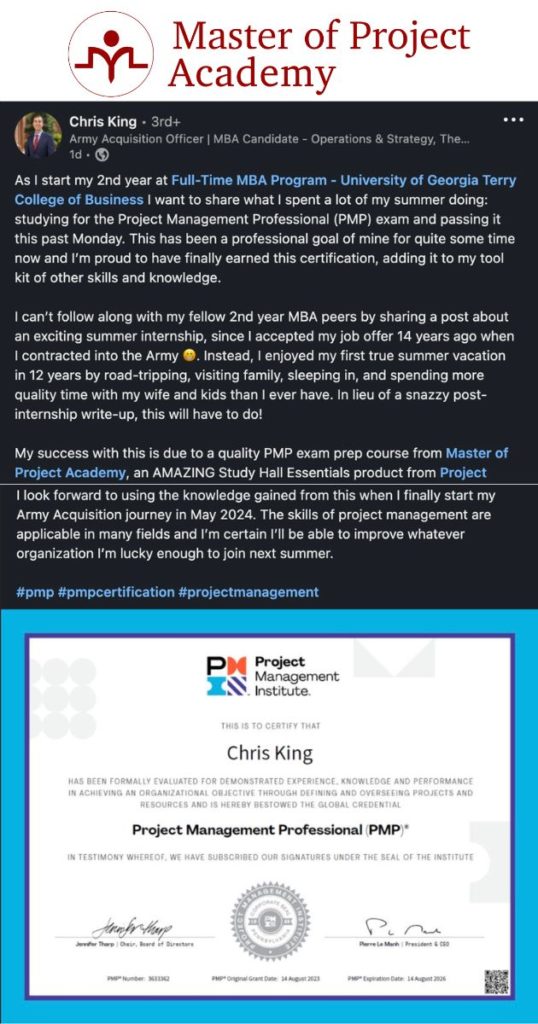
Four days. 35 contact hours — the full training requirement for your exam application. Live, instructor-led sessions where you can actually ask the question that’s bothering you. And a 99.6% first-time pass rate behind it.
Two options:
- Standard — $1,079 (was $1,570)
- Pro — $1,279 (was $1,697), which adds lifetime access to the self-paced course plus one hour of PMP® one-on-one online coaching with a mentor
Reserve your seat in the July PMP Live Class →
Don’t be the first mouse
The early bird story is the one we all got told, because it flatters the instinct to hurry. But hurrying at a trap is just hurrying at a trap.
Be the second mouse. Let everyone else discover where the exam’s traps are. Learn from a room full of people who’ve already mapped them. Then walk in, take your cheese, and put three letters after your name.
The July class is scheduled. The trap is already mapped.
Next in this series: First-Mouse Mistakes — 5 PMP Prep Errors That Spring the Trap. The specific ways smart project managers sabotage their own exam prep, and how to sidestep each one.