The PMP exam intimidates even experienced project managers. With a 200-question format, scenario-based complexity, and stakes that include career advancement and credential credibility, the pressure is substantial. Yet some professionals walk into that testing center with quiet confidence—and walk out certified.
What separates first-time passers from those who require multiple attempts? The answer lies not in intelligence or experience but in preparation methodology. These five professionals share their journeys from PMP candidacy to first-time certification success.
The First-Time Pass Phenomenon: What 99.6% Really Means for Your PMP Journey
Case Study 1: The Career Changer—Alicia Morales
Background: Financial analyst transitioning to project management
Industry: Banking and financial services
Preparation time: 10 weeks
Result: Passed with Above Target in all three domains
Alicia faced a unique challenge. With fifteen years in financial analysis but minimal formal project management experience, she needed to demonstrate competency in a field where she’d operated primarily as a stakeholder, not a leader.
“I’d contributed to dozens of projects,” Alicia explains, “but always from the finance side. I understood budgeting and forecasting, but I’d never led a project team through initiation, planning, execution, monitoring, and closing.”
Generic PMP courses presented another obstacle: examples and scenarios drawn primarily from IT and construction didn’t resonate with her financial services context. She needed to understand how PMI’s framework applied in her world—regulatory compliance projects, system implementations with risk management constraints, and initiatives where stakeholder management meant navigating complex organizational politics.
Master of Project Academy’s approach changed everything. “The curriculum included financial services case studies,” she recalls. “I wasn’t just learning about risk management in abstract terms—I was analyzing scenarios involving regulatory audits, compliance deadlines, and reputational risk. Suddenly, PMI’s framework made sense in my context.”
Why Project Management Specialists Beat General Learning Platforms Every Time?
The breakthrough came during a practice scenario involving earned value management. “I’d always thought of EVM as theoretical,” Alicia shares. “But when the instructor showed how it applied to tracking a core banking system upgrade—translating technical progress into financial terms executives could understand—everything clicked. That’s exactly what I’d do in my role.”
Alicia’s preparation strategy focused on translating her domain expertise into PMI’s language. Rather than trying to learn project management from scratch, she mapped her existing financial knowledge onto PMI’s framework, identifying where her experience aligned and where she needed to develop new competencies.
“The diagnostic assessments were crucial,” she notes. “They immediately identified that I was strong on business acumen and cost management but needed work on team performance domain concepts like conflict resolution and servant leadership. I could focus my study time where it mattered most.”
On exam day, Alicia encountered scenarios remarkably similar to those she’d practiced. “Question 47 was almost identical to a case study I’d worked through the week before,” she remembers. “I’d analyzed that exact stakeholder dynamic—competing executive priorities during a scope change—and knew exactly how PMI wanted me to think about the response.”
Key success factor: Industry-specific contextualization that connected PMI’s framework to her domain expertise, accelerating both comprehension and retention.
Case Study 2: The Experienced PM—James Kowalski
Background: Ten years as an IT project manager
Industry: Enterprise software development
Preparation time: 8 weeks
Result: Passed on first attempt after failing twice with other platforms
James represents a common pattern: experienced project managers who struggle with the PMP exam despite years of successful project delivery. His story illustrates the gap between doing project management and passing the PMP exam.
“I’d delivered multi-million dollar projects successfully for a decade,” James explains. “I thought the exam would validate what I already knew. My first two attempts proved me wrong.”
James had used two popular platforms before Master of Project Academy. Both offered comprehensive content coverage and practice questions. Both left him unprepared for the actual exam.
“The other platforms taught me what the PMBOK Guide says,” James reflects. “But the exam doesn’t ask what the PMBOK says—it asks what you should do in complex, ambiguous situations. That’s a completely different skill.”
The revelation came during his first week with Master of Project Academy. “An instructor explained that experienced PMs often fail because we answer based on what works in our organizations, not what PMI’s framework prescribes. In my company, we’d escalate certain issues to the sponsor immediately. But PMI’s servant leadership approach might suggest trying team-level resolution first. I’d been answering based on my experience, not PMI’s methodology.”
Master of Project Academy vs. Udemy: A Real Comparison Beyond Price Tags
This realization transformed James’s preparation. He stopped thinking about what he’d do and started analyzing what PMI’s framework would prescribe. “The scenario-based practice was essential,” he notes. “Each scenario included detailed explanations of why certain responses aligned with PMI’s methodology and why others, though potentially effective in practice, didn’t match the exam’s expectations.”
James also benefited from the community aspect. “I connected with other experienced PMs preparing for the exam. We’d discuss scenarios where our instincts conflicted with PMI’s approach, helping each other understand the framework’s logic rather than just memorizing ‘correct’ answers.”
His breakthrough moment came during a practice exam. “I was getting 85%+ on practice tests, but I still didn’t feel confident. Then an instructor reviewed my incorrect answers and identified a pattern: I was choosing the most decisive action in conflict situations when PMI’s framework favored collaborative approaches first. Once I adjusted my mental model, everything fell into place.”
On exam day, James felt the difference. “I wasn’t second-guessing myself. When scenarios presented conflicts between what I’d do based on experience and what PMI’s framework suggested, I confidently chose the framework. I finished with thirty minutes to spare and knew I’d passed before seeing the results.”
Key success factor: Learning to separate organizational practices from PMI’s methodology, developing the ability to answer according to the framework rather than personal experience.
Enroll in our PMP Courses to pass your PMP exam on your first attempt.
- PMP® Online Class Virtual Training – 4 Days – 35 Contact Hours
- PMP® Certification Training – 35 Contact Hours Self-Paced Online PMP® Training
Case Study 3: The Time-Constrained Professional—Mei Lin
Background: Healthcare project manager with two young children
Industry: Hospital administration and clinical systems
Preparation time: 12 weeks with limited study hours
Result: Passed on first attempt while working full-time
Mei Lin’s challenge wasn’t competency—it was time. As a project manager overseeing electronic health record implementations while parenting two children under five, she had perhaps ten hours weekly for PMP preparation.
“I couldn’t afford inefficient studying,” Mei explains. “Every hour had to count. I needed a system that maximized learning in minimal time.”
Most PMP platforms assume students can dedicate 15-20 hours weekly. Their curricula are designed for comprehensive coverage, requiring students to watch hours of video content before reaching practical application.
Master of Project Academy’s adaptive learning approach solved Mei’s problem. “The diagnostic assessment identified exactly where I needed to focus,” she shares. “I already understood stakeholder management from years of navigating physician-administration dynamics. I didn’t need to spend hours on that content. But I was weak on agile concepts since most healthcare projects use predictive approaches. The system directed me to exactly what I needed.”
Mei’s study strategy leveraged micro-learning. “I’d watch a fifteen-minute module during my lunch break, then practice scenarios for twenty minutes after the kids went to bed. The mobile-optimized platform meant I could review flashcards while waiting for appointments.”
The scenario-based approach particularly suited her time constraints. “Instead of reading theoretical content and then later seeing how it applied, each concept was immediately paired with realistic scenarios. I was learning and practicing simultaneously, cutting study time nearly in half.”
Mei also utilized the community forums strategically. “When I encountered confusion, I’d post a question before bed. By morning, an instructor or experienced student had responded with a clear explanation. I never wasted time stuck on a concept.”
Her healthcare background presented interesting challenges. “PMI’s framework sometimes conflicted with healthcare regulatory requirements,” she notes. “For example, change control in a clinical system has specific compliance implications. The instructors helped me understand when to apply healthcare-specific knowledge and when to default to PMI’s methodology for exam purposes.”
On exam day, Mei’s efficient preparation paid off. “I recognized scenario patterns I’d practiced,” she recalls. “I wasn’t trying to remember content—I was applying frameworks I’d internalized through repetition. Even with limited preparation time, I felt thoroughly ready.”
Key success factor: Adaptive learning that maximized limited study time by focusing on knowledge gaps rather than comprehensive content review, combined with micro-learning strategies suited to demanding schedules.
How Burn Rates Changes Everything About Learning Project Management?
Case Study 4: The Global Professional—Rajesh Kumar
Background: IT project manager in multinational corporation
Industry: Global technology services
Preparation time: 9 weeks
Result: Passed on first attempt with Above Target in two domains
Rajesh managed projects across four continents, coordinating teams in India, the United States, Germany, and Brazil. His challenge wasn’t project management competency—it was translating diverse global practices into PMI’s standardized framework.
“In India, we emphasize hierarchical decision-making,” Rajesh explains. “In the US, teams expect more autonomy. In Germany, process rigor is paramount. In Brazil, relationship-building drives success. I needed to understand how PMI’s framework addressed these cultural variations.”
Many PMP platforms treat project management as culturally neutral, ignoring how practices vary globally. This created confusion for Rajesh. “Should I answer questions based on what works in my context or what the framework prescribes?”
Master of Project Academy’s global perspective provided clarity. “The instructors acknowledged cultural variations while emphasizing that the PMP exam tests PMI’s methodology,” Rajesh shares. “They helped me understand servant leadership not as an American concept but as a globally applicable approach adapted to local contexts.”
The curriculum included scenarios reflecting global project challenges: time zone coordination, cultural communication differences, distributed team management, and stakeholder engagement across hierarchical variations.
“One practice scenario involved a conflict between team members from high-context and low-context cultures,” Rajesh recalls. “The question tested whether I understood that effective communication requires adapting style to audience, not imposing a single approach. That cultural intelligence perspective aligned with my experience while fitting PMI’s framework.”
Rajesh also benefited from Master of Project Academy’s international student community. “I connected with PMs from twenty countries. We’d discuss how PMI’s principles applied in our contexts, deepening my understanding of the framework’s flexibility within consistent principles.”
His preparation included translating his multilingual project experience into PMI’s language. “I realized that what I called ‘stakeholder alignment sessions’ in India corresponded to PMI’s ‘consensus-building meetings.’ Same concept, different terminology. Understanding these translations was crucial.”
On exam day, Rajesh’s global perspective proved advantageous. “Several scenarios involved cross-cultural team dynamics. My experience managing global projects meant I immediately recognized the situations and knew how PMI’s framework would address them.”
Key success factor: Understanding how to translate diverse global project management practices into PMI’s standardized framework while maintaining cultural intelligence and contextual awareness.
Why “Culture Eats Strategy for Lunch” Is the Key to High-Performing Teams and Organizations
Case Study 5: The First-Time Project Manager—Sophie Anderson
Background: Marketing manager taking on first formal PM role
Industry: Digital marketing and advertising
Preparation time: 11 weeks
Result: Passed on first attempt despite limited formal PM experience
Sophie represents an increasingly common scenario: professionals managing projects without formal project management training. She’d led marketing campaigns for years but never used PMI’s framework or terminology.
“I had three years of project experience required for the PMP but felt like an imposter,” Sophie admits. “Other candidates had project management job titles. I was a marketing manager who happened to manage projects.”
This perception initially undermined her confidence. “I assumed I’d need longer preparation since I lacked formal PM training. But Master of Project Academy’s approach showed me that marketing campaign management is project management—I just hadn’t been using PMI’s language.”
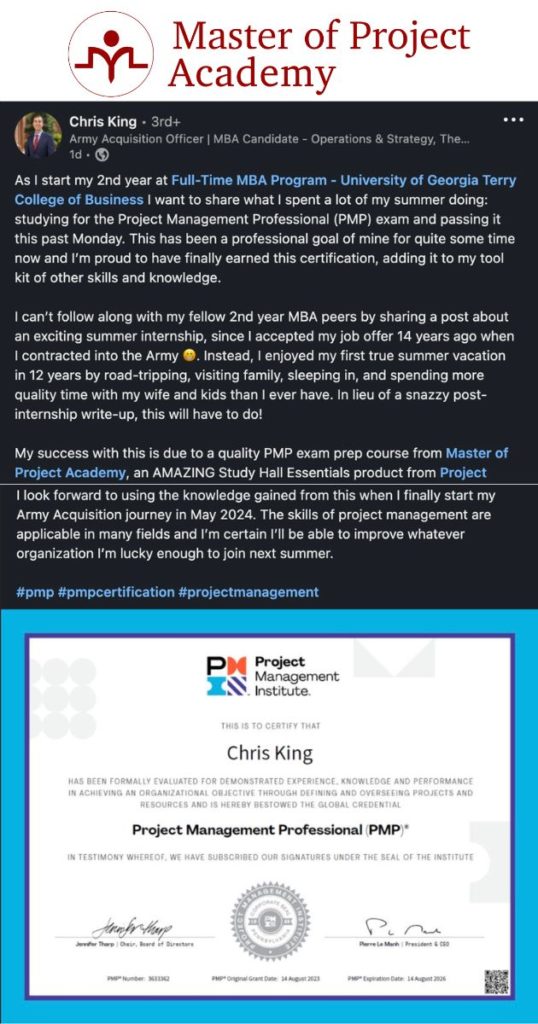
The curriculum helped Sophie recognize her existing competencies. “When I learned about stakeholder management, I realized I’d been doing this with clients and creative teams for years. When I studied resource allocation, I recognized my experience balancing designer time across competing campaigns. I wasn’t starting from zero—I was translating existing skills into PMI’s framework.”
Sophie’s marketing background provided unexpected advantages. “The exam emphasizes business value and stakeholder satisfaction—exactly what marketing trains you to prioritize. While IT PMs sometimes struggled with customer-centric questions, those felt natural to me.”
However, she needed to develop competencies in areas where marketing and traditional project management diverged. “I’d never created a formal risk register or calculated earned value management metrics. Those required genuine learning, not just translation.”
The scenario-based approach accelerated Sophie’s learning curve. “Instead of abstract definitions, I’d see risk management applied to a scenario remarkably similar to launching a product campaign with uncertain market conditions. I could connect new concepts to familiar situations.”
Sophie also leveraged the community. “I partnered with an IT project manager for study sessions. He’d help me understand technical PM concepts; I’d help him think through stakeholder engagement scenarios. That peer learning was invaluable.”
Her breakthrough came during a mock exam. “I scored 82%—solidly passing range—and realized I’d been underestimating myself. My marketing project experience was legitimate project management. I just needed to formalize it using PMI’s methodology.”
On exam day, Sophie’s integrated perspective proved powerful. “I could approach scenarios from both a marketing and PM standpoint, understanding both the business context and the project management framework. That dual perspective made complex scenarios feel manageable.”
Key success factor: Recognizing that diverse project experience—even without formal PM titles—translates into PMI’s framework, combined with targeted learning in traditional PM competencies like quantitative analysis and formal processes.
Common Threads Across First-Time Success
Despite different backgrounds, industries, and challenges, these five professionals share several success factors:
Scenario-based mastery. All emphasized practicing realistic scenarios rather than memorizing content. The PMP exam tests application; preparation must mirror that focus.
Personalized learning paths. Each identified specific knowledge gaps and concentrated study time accordingly, avoiding wasted effort on already-mastered content.
Expert guidance at critical moments. Whether through instructor explanations, community discussions, or detailed answer feedback, targeted expert input accelerated learning beyond what self-study could achieve.
Contextual understanding. Rather than treating PMI’s framework as abstract theory, each connected it to their professional reality, making concepts meaningful and memorable.
Confidence through preparation. None walked into the exam hoping for the best—they knew they were ready because their preparation had been specifically designed for first-time success.
Your First-Time Pass Starts Here
These stories aren’t exceptional—they’re typical of Master of Project Academy students. The 99.6% pass rate exists because the preparation methodology consistently produces first-time success.
Whether you’re a career changer, experienced PM, time-constrained professional, global practitioner, or first-time formal project manager, the pathway to first-time certification success is clear: specialized preparation designed for the specific challenges you face.
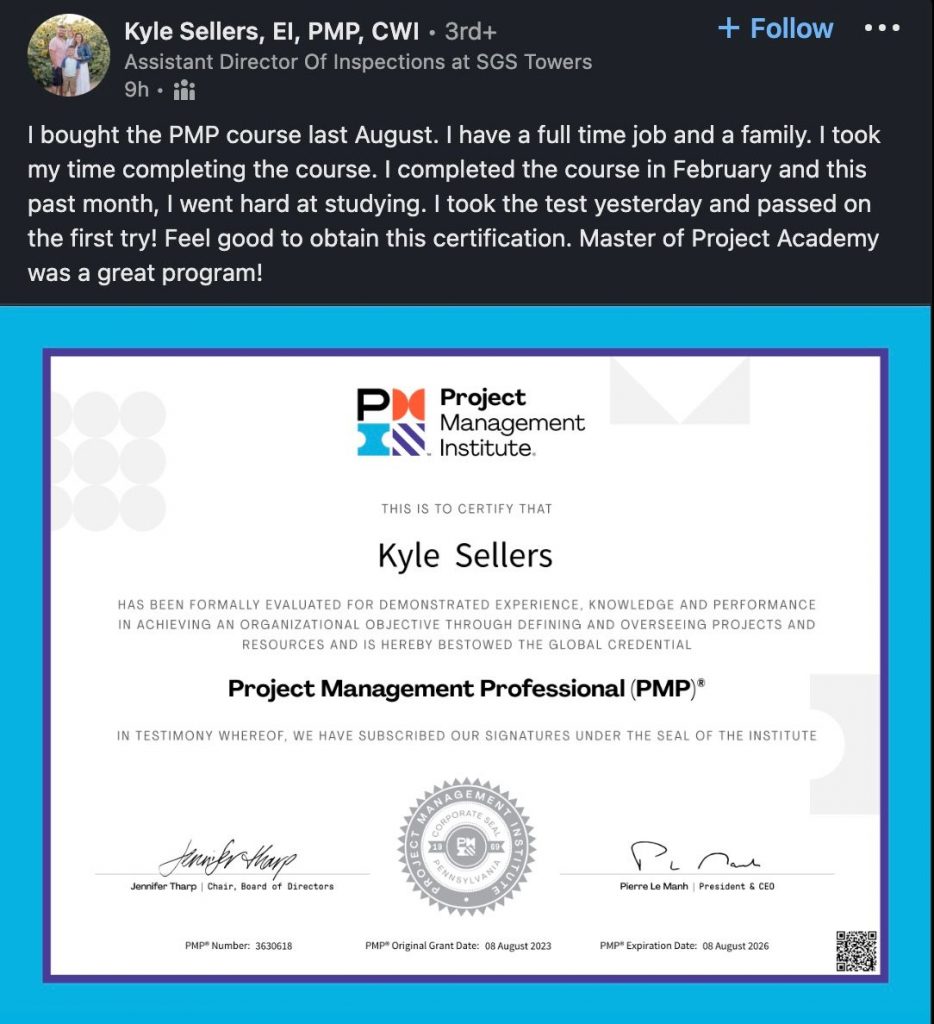
Ready to write your first-time pass story? Explore Master of Project Academy’s PMP Certification Training and join thousands who’ve turned PMP certification from an intimidating challenge into an achievable milestone. Your success story starts with the right preparation partner.
Frequently Asked Questions
Q: Can I really pass the PMP exam on my first attempt without extensive project management experience?
A: Yes. The PMP requires 36 months of project leadership experience, but formal PM job titles aren’t necessary. Many first-time passers, like Sophie, come from roles where they managed projects without formal PM titles. The key is translating your experience into PMI’s framework through targeted preparation.
Q: How do I know if I’m ready to take the exam?
A: Consistent performance of 75%+ on full-length practice exams under timed conditions indicates readiness. Additionally, you should feel confident explaining why incorrect answers are wrong, not just identifying correct answers—this demonstrates the depth of understanding required for first-time success.
Q: What if I have limited time for exam preparation?
A: Adaptive learning systems maximize efficiency by focusing study time on knowledge gaps rather than comprehensive review. Most time-constrained professionals succeed with 10-12 weeks of focused preparation, dedicating 8-10 hours weekly to high-value activities like scenario practice and targeted content review.
Q: Is specialized preparation really necessary if I’m an experienced project manager?
A: Yes. Experience managing projects doesn’t automatically translate into passing the PMP exam. The exam tests PMI’s methodology, which may differ from your organizational practices. Experienced PMs often need to learn to separate “what works” from “what PMI prescribes”—a distinction that specialized preparation addresses directly.
Q: How do I choose between self-paced and instructor-led preparation?
A: Consider your learning style and schedule flexibility. Self-paced works well for disciplined learners with irregular schedules. Instructor-led provides structure, accountability, and real-time clarification. Many successful students combine both: self-paced content consumption with instructor-led scenario analysis and Q&A sessions.
Creating a Winning PMP Application: Meeting PMI’s Guidelines