
Every year, thousands of project management professionals sit for the PMP exam. Approximately 60% pass on their first attempt according to industry data. Yet at Master of Project Academy, something remarkable happens: 99.6% of students pass—and most do it on their first try.
This isn’t luck. It’s not about easier exams or lowered standards. It’s the result of a meticulously designed learning system that transforms how professionals prepare for one of the most challenging certifications in business.
6 Reasons 99.1% of Our Students Pass the PMP Exam on the First Attempt (and How You Can Too)
The Anatomy of a First-Time Pass
Sarah Chen, a construction project manager from Toronto, had attempted the PMP exam twice before finding Master of Project Academy. “I’d spent months with generic study materials,” she recalls. “I knew the concepts, but I couldn’t apply them the way PMI wanted. Within six weeks of switching to MoPA’s program, everything clicked. I passed with Above Target in all three domains.”
What Sarah discovered—and what separates first-time passers from repeat test-takers—is the difference between knowing project management and understanding how PMI evaluates project management competency.
The PMP exam doesn’t test whether you’ve memorized the PMBOK Guide. It assesses whether you can make sound judgments in realistic scenarios, often with incomplete information and competing priorities. This requires a depth of understanding that generic platforms simply cannot provide.
Why Industry Averages Don’t Apply Here
The 40% failure rate among first-time PMP candidates exists for predictable reasons:
Inadequate scenario practice. Most platforms offer multiple-choice questions that test recall, not application. When exam day arrives, candidates encounter complex, multi-layered scenarios they’ve never practiced navigating.
Generic instruction without context. Project management principles apply differently across industries. A software development sprint review differs fundamentally from a construction phase gate, yet most courses teach these concepts in abstract terms divorced from real-world application.
Outdated content delivery. The 2021 PMP exam revision emphasized agile and hybrid methodologies, servant leadership, and business acumen. Many platforms still teach to the old exam format, leaving students unprepared for what they’ll actually encounter.
Lack of personalized support. When confusion strikes—and it will—students need expert guidance, not forum discussions or chatbots. The difference between understanding risk response strategies conceptually and knowing which strategy to apply in a given scenario often comes down to a single clarifying conversation with an experienced instructor.
The Master of Project Academy Difference
Marcus Rodriguez passed his PMP on the first attempt after just eight weeks of preparation. “I’d been project managing for twelve years,” he shares. “I thought I knew this stuff. But MoPA showed me the gap between doing project management and thinking like PMI expects.”
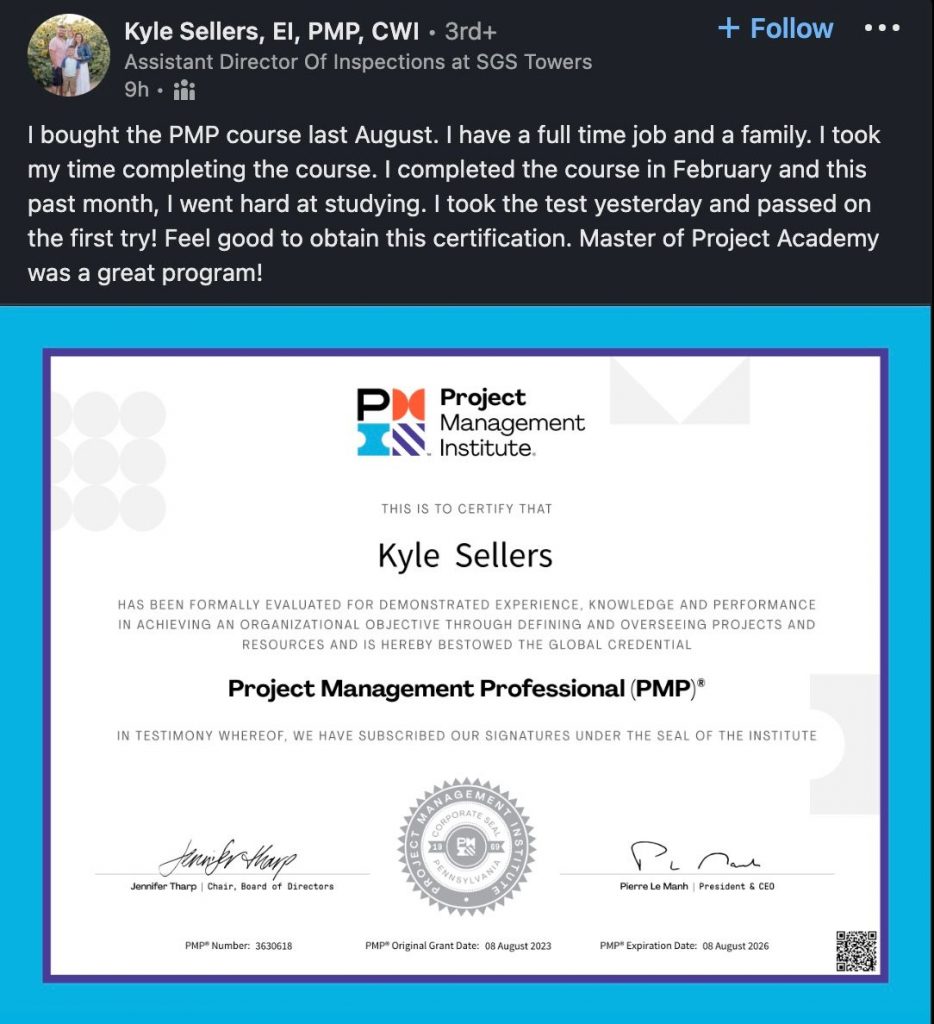
That gap-closing process happens through several interconnected elements:
Scenario-based learning architecture. Every concept is immediately connected to realistic situations. Students don’t just learn about stakeholder engagement—they analyze case studies where stakeholder resistance threatens project success and develop response strategies.
Industry-specific contextualization. Whether you’re in IT, healthcare, construction, or financial services, the curriculum connects PMI’s framework to your daily reality. This relevance accelerates comprehension and retention.
Iterative assessment methodology. Students take diagnostic assessments that identify knowledge gaps with precision. The platform then adapts, providing targeted reinforcement where it’s needed most. By exam day, every student has practiced scenarios similar to what they’ll encounter, building both competence and confidence.
Expert instructor accessibility. When Priya Patel encountered confusion about earned value management calculations, she didn’t search forums or re-watch videos. She posted a question and received a detailed explanation from a PMP-certified instructor within hours. “That one interaction saved me days of confusion,” she notes.
The Compounding Effect of Proper Preparation
First-time pass rates matter beyond the obvious time and cost savings. They represent something more fundamental: the transfer of genuine competence.
Jennifer Wu, now a senior program manager at a Fortune 500 technology company, reflects on her experience: “Passing the first time wasn’t just about the certification. It was proof that I’d actually learned to think differently about project management. The strategies I learned preparing for the exam are the same ones I use leading $50M+ initiatives today.”
This is the hidden value in Master of Project Academy’s approach. The goal isn’t merely to pass an exam—it’s to develop practitioners who can immediately apply advanced project management thinking to create organizational value.
Enroll in our PMP Courses to pass your PMP exam on your first attempt.
- PMP® Online Class Virtual Training – 4 Days – 35 Contact Hours
- PMP® Certification Training – 35 Contact Hours Self-Paced Online PMP® Training
The Science of Retention and Recall
Cognitive science research reveals that long-term retention requires spaced repetition, active recall, and contextual learning. Master of Project Academy’s curriculum design incorporates all three:
Spaced repetition algorithms ensure concepts are reviewed at optimal intervals, moving knowledge from short-term to long-term memory.
Active recall exercises force students to retrieve information rather than passively reviewing it, strengthening neural pathways.
Contextual anchoring connects each principle to memorable scenarios, creating mental models that persist long after certification.
The result? Students don’t just pass—they remember what they learned and apply it throughout their careers.
Cultivating Success: How Regenerative Agriculture Principles Can Help You Pass the PMP Exam
What First-Time Success Reveals About Mastery
David Okonkwo, who passed with Above Target scores in all domains, offers this insight: “The difference between my first failed attempt with another platform and my successful attempt with MoPA was night and day. Before, I was trying to memorize information. With MoPA, I was developing judgment.”
That distinction—between information and judgment—explains why some students need multiple attempts while others succeed immediately. Information can be crammed. Judgment must be cultivated through deliberate practice with expert feedback.
When students consistently pass on their first attempt, it signals that the learning system has successfully built not just knowledge but discernment—the ability to recognize patterns, evaluate options, and select optimal responses under exam conditions.
Your Path to First-Time Success
The 99.6% pass rate isn’t a guarantee—it’s an outcome of commitment meeting methodology. Students who engage fully with the curriculum, complete the practice scenarios, and seek clarification when needed join the ranks of first-time passers.
The question isn’t whether you’re capable of passing the PMP exam on your first attempt. The question is whether you’re willing to prepare using a system designed for that specific outcome.
Ready to join the 99.6%? Explore Master of Project Academy’s PMP Certification Training and discover why specialized preparation delivers generalist platforms cannot match. Your first-time pass starts with choosing the right preparation partner.
PMP in 2026: The Smartest Certification Move You Can Make Before the Exam Changes
Frequently Asked Questions
Q: How does Master of Project Academy achieve such a high pass rate?
A: The 99.6% pass rate results from specialized curriculum design, scenario-based learning, expert instruction, adaptive assessment, and personalized support—all aligned specifically with PMP exam requirements rather than generic project management education.
Q: What should I do if I’ve already failed the PMP exam?
A: Many successful MoPA students previously failed with other platforms. Start with a diagnostic assessment to identify specific knowledge gaps, then follow a structured review plan focusing on scenario analysis rather than content review. Most previously unsuccessful students pass within 6-8 weeks using this approach.
Q: How long does it typically take to prepare using Master of Project Academy?
A: Most students prepare in 8-12 weeks with 10-15 hours of weekly study. However, the adaptive curriculum adjusts to your pace and prior knowledge, making efficient preparation possible even with demanding professional schedules.
Q: What makes scenario-based learning more effective than traditional study methods?
A: The PMP exam tests application, not memorization. Scenario-based learning mirrors exam conditions, developing the judgment and pattern recognition required for first-time success. Traditional methods teach what to know; scenario-based learning teaches how to think.
Q: Is the 99.6% pass rate verified?
A: Yes. Master of Project Academy tracks student outcomes through post-exam surveys and PMI’s exam reporting. The pass rate reflects actual student performance, not marketing claims.