Something extraordinary is happening in the global economy.
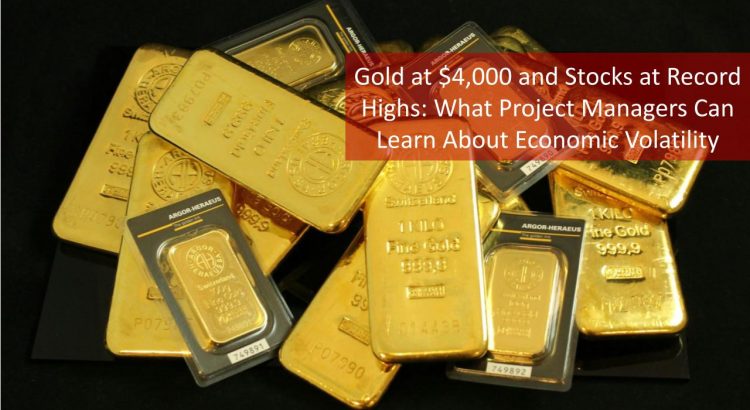
Gold is soaring past $4,000 an ounce.
Stocks are touching record highs.
And for those who know how to read the signs, these aren’t just market numbers—they’re signals. Signals that the world is shifting beneath our feet.
For project managers, this moment is a masterclass in adaptability, leadership, and strategic awareness. The question is: are you prepared to manage projects in a world that defies economic gravity?
Skills Are the New Currency: When Financial Systems Shift, the Safest Wealth Is You
The Hidden Story Behind Gold and Stocks Rising Together
When both gold and equities rise simultaneously, it means two forces are at play:
- Fear — investors rush into gold seeking safety.
- Greed — investors pile into stocks chasing returns.
It’s a paradox that tells us one thing: confidence and caution now coexist.
In this kind of environment, project managers can’t simply “follow process.” They must learn to read financial signals like market analysts, adapt faster than algorithms, and communicate with the clarity of leaders steering billion-dollar portfolios.
And this is precisely where Master of Project Academy’s PMP and Agile Training Programs become game-changing. They don’t just teach you how to manage a project—they teach you how to think like a strategist.
Lesson 1: Turn Volatility into Vision
Volatility doesn’t destroy value—it reveals leadership.
When gold spikes and markets whirl, organizations need project managers who can adjust scopes, timelines, and budgets with confidence.
By applying frameworks you learn in PMP Certification Training or Agile Project Management Courses, you gain the ability to stay composed, make strategic trade-offs, and lead your team through uncertainty with precision.
The best project managers don’t react to volatility—they capitalize on it.
Facing Cuts to Your Portfolio, Program, or Project? Steal This Playbook to Defend and Thrive
Lesson 2: Understand Stakeholders the Way Investors Understand Markets
Markets move on emotion and perception—so do stakeholders.
When uncertainty rises, your executives crave clarity. They don’t want reassurance; they want strategy. A project manager trained in Master of Project Academy’s communication and leadership modules knows how to:
- Present complex risks as clear, actionable data.
- Frame uncertainty as opportunity.
- Build trust by forecasting multiple “what if” scenarios.
This is the kind of confidence that makes leaders say: “I want this person managing our critical projects.”
Leading Projects in a World Where Inflation Never Really Dies
Lesson 3: Diversify Your Project Portfolio Like a Financial Portfolio
Smart investors don’t bet everything on one stock—and neither should organizations.
Diversification is a risk management principle that every PMP-certified professional learns to apply in project portfolios.
With the right training, you’ll know how to:
- Balance innovation projects with stability projects.
- Spread operational risks across teams and technologies.
- Ensure your organization’s project portfolio stays resilient—no matter what the markets do.
The project managers who understand these financial parallels become indispensable in boardrooms.
What is the Relation Between Reserve Analysis and Risk Management?
Lesson 4: Speak the Language of Capital
Every executive is thinking about the cost of capital, not just cost of labor.
That means the most valuable project managers are those who can explain how projects create returns, mitigate losses, and align with business value.
When you learn from Master of Project Academy’s PMP or CAPM Courses, you gain the financial fluency to:
- Discuss NPV (Net Present Value) and ROI with executives.
- Justify your project’s funding based on cost of capital models.
- Influence strategic investment decisions.
That’s how you stop managing projects—and start shaping strategy.
Master of Project Academy Blog – FAQ: Go‑to‑Market Strategy for 2025
Lesson 5: Lead Through Calm in Chaos
Volatility tests character.
While others panic, leaders with structured project management training project calm, direction, and clarity.
The mindset and frameworks you’ll master through Instructor-Led PMP or PM Skills Courses give you the tools to guide teams with purpose. You’ll learn to:
- Communicate with empathy and precision.
- Keep morale high during uncertainty.
- Reinforce confidence through structure and transparency.
In unstable times, psychological safety isn’t optional—it’s leadership.
Never Let a Good Crisis Go to Waste: Turning Setbacks into Opportunities for Growth
Lesson 6: Make Scenario Planning Your Secret Weapon
What if your project loses 15% of its budget next quarter?
What if inflation spikes another 3%?
What if supply chains freeze again?
Great project managers don’t wait for “what ifs.” They plan for them.
By mastering scenario planning techniques taught in Master of Project Academy’s Risk Management and Agile Courses, you’ll be able to run simulations, adjust strategies in real time, and present executives with clear, data-backed decisions.
That’s what separates a good manager from a future program director.
What Project Managers Can Learn from a “False Flag” Scenario
Lesson 7: Use Economic Shifts to Accelerate Your Career
Every market disruption creates opportunity. Those who understand volatility—who can lead confidently while others freeze—become the next generation of senior leaders.
Project managers who sharpen their skills now are preparing for tomorrow’s promotions, portfolios, and partnerships.
And this is the perfect moment to take the next step in your professional development journey with Master of Project Academy—where you don’t just learn what to do, but how to think like a global strategist.
System Project Management and the Grand Master Strategy: Uniting Execution and Outcome
FAQ: What It Means When Gold Is at $4,000 and Stocks Are at Record Highs
- Why are both gold and stocks rising together?
Because global liquidity is high and uncertainty is even higher. Investors want safety and returns—so they chase both. - What does this mean for project managers?
Budgets, timelines, and business priorities can shift rapidly. Understanding economic context is now part of being an effective leader. - How can project managers prepare?
Upgrade your skills. Learn scenario planning, financial modeling, and agile adaptability through Master of Project Academy’s courses. - Should companies delay projects during economic uncertainty?
No—organizations that adapt and invest through volatility often emerge stronger. Trained project managers can guide these strategic shifts. - Which Master of Project Academy courses are most valuable now?
- PMP Certification Training for leadership and strategic thinking.
- Agile Project Management Course for rapid adaptation.
- Risk Management and PM Skills Courses for handling uncertainty.
- How can I stand out in a volatile job market?
Show that you can manage complexity, communicate with confidence, and link project outcomes to financial results. That’s exactly what Master of Project Academy teaches.
2030: The World Belongs to Those Who Build — Projects, Products, Solutions, Systems
Final Thought: Don’t Watch the Markets—Learn From Them
Gold at $4,000 and record-high stocks are more than economic data—they’re a leadership test.
The world rewards those who can interpret volatility as opportunity. And that’s what great project managers do best.
Now is the moment to turn insight into advantage.
To move from reactive to strategic.
To master the frameworks, language, and confidence that define tomorrow’s leaders.
👉 Enroll in a Master of Project Academy course today—and learn how to lead projects with the clarity and composure that economic uncertainty demands.